Beneath Still Waters: The Village That Vanished

The first time I saw Ashford Valley was from my grandmother's faded photographs. The black-and-white images showed a vibrant mountain community: a white church with a tall spire, a general store with rocking chairs on the porch, and streets lined with elms where children played. My grandmother, Eleanor, spoke of cherry festivals in spring and harvest dances in autumn, of swimming in the clear waters of the Blackwater River on hot summer days.
"It's all under the reservoir now," she would say, her voice tinged with something between sorrow and acceptance.
When I inherited her cottage on the edge of Blackwater Reservoir, I finally understood her attachment to this place. From my deck, I could see the vast expanse of water that had submerged Ashford Valley sixty years ago, sacrificed in the name of progress to provide water and electricity to the growing cities downstream.
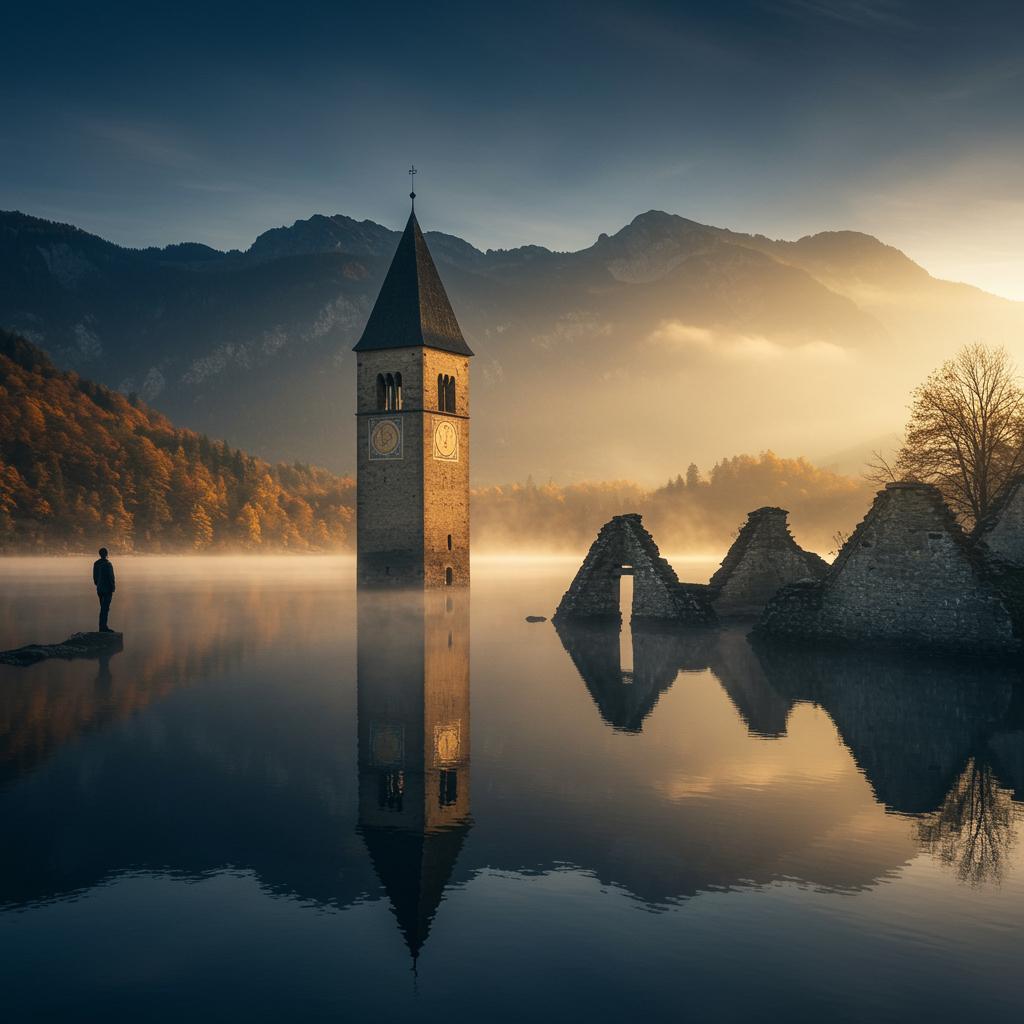
On still days, when the morning mist clung to the water's surface, I imagined I could see the church spire beneath the water. It was just a trick of light reflecting off the depths, but the locals had stories—of bells ringing underwater during storms, of lights moving beneath the surface on the anniversary of the flooding.
I dismissed these as folklore until the summer drought of 2023.
The water levels dropped lower than they had in decades. First, the tops of trees emerged—skeletal branches reaching for air after half a century underwater. Then came rooftops, the church spire confirming what everyone knew lay beneath. As the waters receded further, the village revealed itself piece by piece: the crossroads, the foundations of the general store, the schoolhouse.
The authorities closed the area, citing safety concerns, but people came anyway. Former residents, now elderly, brought their children and grandchildren. They walked through the mud-caked streets, stepping carefully over the ruins of their former lives.
I found my grandmother's childhood home using an old map she had drawn for me years ago. The structure was gone, but the stone foundation remained, and miraculously, within what had been their garden, a single rosebush had survived. Dormant all these years beneath the water, it was now blooming defiantly with pale pink flowers.
I was not prepared for what happened one evening as sunset painted the exposed village in amber light. A woman stood by the church ruins, her back to me. Her dress was outdated, her gray hair pinned up in a style no one wore anymore. When she turned, for a moment, I thought it was my grandmother as a young woman. The resemblance to the photographs was uncanny.
Then she was gone, like mist burning off in the morning sun.
Others reported similar experiences: figures walking through empty doorways, children's laughter echoing where no children stood, the phantom smell of baking bread near the collapsed bakery.
Scientists came with their instruments and theories about methane gases, light refraction, and the power of suggestion. Paranormal enthusiasts arrived with cameras and EMF detectors. Religious groups held services by the exposed church foundation.
Then the rains came. Day after day of relentless downpour. The reservoir began to fill again, swallowing Ashford Valley for the second time.
The night before the village disappeared completely beneath the rising waters, I stood on the shore with dozens of others, holding candles against the darkness. We watched in silence as the church foundation—the last visible part of the village—slipped beneath the surface.
Later that night, alone in my grandmother's cottage, I found a box I had never noticed before, tucked behind a loose board in the attic. Inside were letters dated in the weeks before the valley was flooded. They revealed a truth the official history had omitted: the residents had been given just thirty days to evacuate, compensation had been minimal, and protests had been ignored.
The final letter, written by my grandmother's father, spoke of a town meeting where something had been decided—something that was not to be put in writing. The letter ended with a cryptic line: "What we've buried here will remain, even beneath the water."
Since then, I have been researching, diving into archives, interviewing the few remaining former residents. Most stay silent or change the subject. But occasionally, I catch a knowing look, a half-smile that suggests there is more to the story of Ashford Valley than a simple tale of progress claiming a small mountain town.
Whatever secret lies beneath the still waters of Blackwater Reservoir, it seems determined to surface—whether in the form of unexplained phenomena during droughts or in the whispered stories that still circulate among those who remember what was lost.
As for me, I have decided to stay in my grandmother's cottage. I feel a connection to this place, to the submerged streets where she once walked, to the secrets that sleep beneath the water. And sometimes, when the moon is full and the reservoir is perfectly still, I swear I can hear the church bells ringing from the depths.
The views expressed in this article are those of the author and do not necessarily reflect the views of WriteFlow. WriteFlow does not endorse this content and does not guarantee its accuracy or completeness.



Comments (0)