Memory Thieves

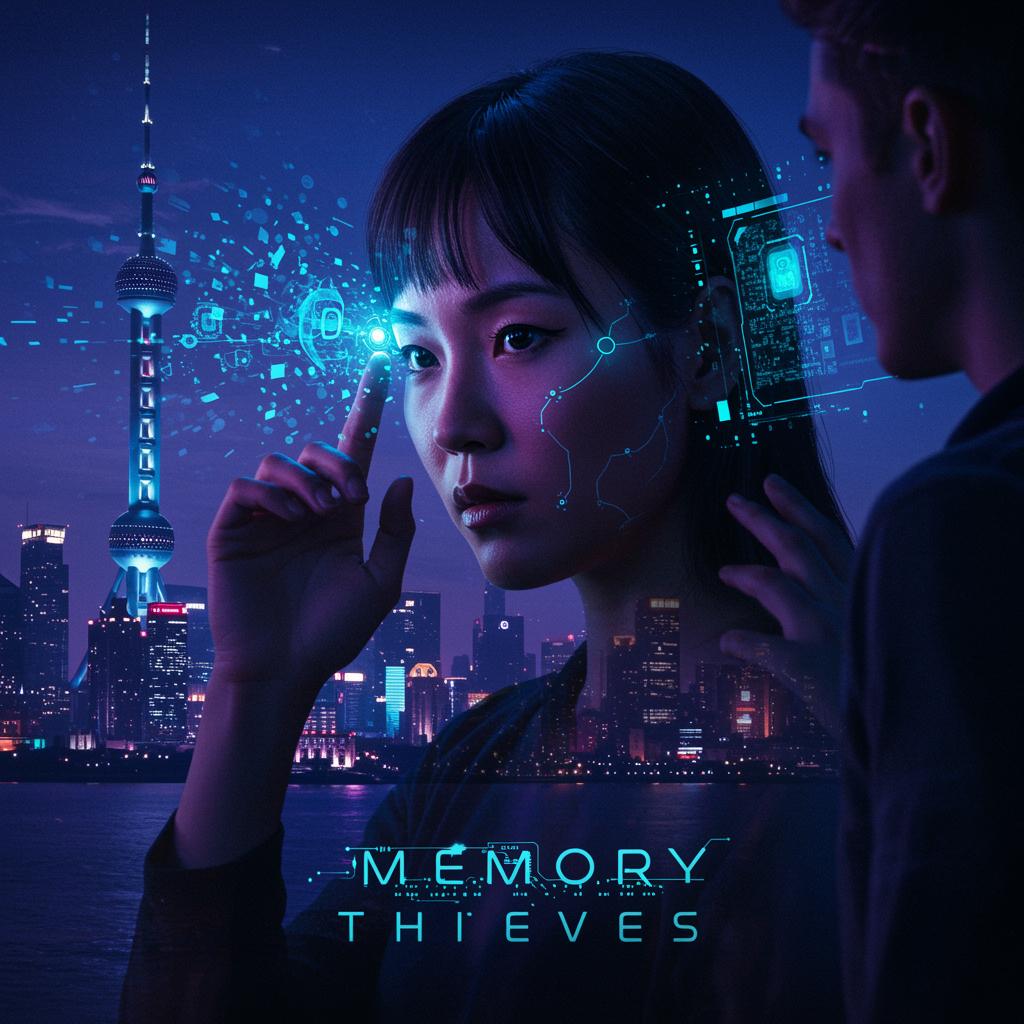
In the indigo twilight of New Shanghai, Elara Chen touched the neural port at her temple, feeling the cool metal beneath her fingertips. Twenty years as a memory architect, and still that moment of connection sent a shiver down her spine. The sensation was familiar yet always new—like touching an old scar that had not quite healed.
"Systems check," she whispered to no one in particular. Her apartment's AI did not respond; she had disabled it months ago. In her line of work, privacy was not just preferred. It was essential.
Her neural display flickered to life across her vision, bathing the sparse apartment in ghostly blue data streams. The memory she had been commissioned to build was nearly complete: a perfect summer day at Lake Geneva, 2065. A wealthy client's anniversary gift to his wife—a memory of a day that never happened, indistinguishable from reality.
The door alert pulsed silently in her peripheral vision. No one should know she was here.
"Display security feed," she commanded. The image that materialized before her made her breath catch. Kazuo Miyamoto—her former partner, former lover, former everything—stood in her hallway, his face a mask of controlled panic.
Elara unlocked the door with a thought. Five years of silence, and here he was.
"They found us," he said without preamble, stepping inside. His eyes were hunted, the lines around them deeper than she remembered.
"Hello to you too, Kaz." She kept her voice steady, though her pulse had quickened. "Who found what, exactly?"
"The Syndicate. They know about Prague."
Prague. The job that had made their careers and destroyed their lives in the same moment. The job that had changed everything about memory architecture forever.
"That's impossible," she said. "We buried those tracks so deep even we could not find them again."
"Someone did." Kazuo moved to her window, peering through the smart-glass at the city below. "You remember Wong Mei? She is dead. So is Nakamura. So are three others from the team."
The chill that ran through Elara had nothing to do with her neural interface. "What do they want?"
"What they have always wanted. The extraction algorithm."
In 2072, memory architecture had been a legitimate, regulated practice—crafting beautiful false memories for the wealthy, preserving real ones for the dying. Then Elara and Kazuo had discovered something revolutionary. Memories could not only be created and preserved but extracted. Whole, intact experiences could be pulled from one mind and implanted in another.
The implications were staggering. Experience itself became a commodity. Knowledge could be transferred without learning. Skills without practice. Intimacy without vulnerability.
And secrets without confession.
"I destroyed it," Elara said, the lie flowing as smoothly as it had for five years. "After what happened with the test subject, I wiped everything."
Kazuo turned to her, his expression unreadable. "We both know that is not true."
Before she could respond, her building's emergency alarm screamed to life. Red warning lights pulsed through her apartment.
"They are here," Kazuo said.
"Who is 'they'?"
"Memory thieves," he replied, reaching for her hand. "Like we used to be. But much, much worse."
By daybreak, they were on a hypersonic bound for the African Union, Elara's neural archive—containing the only copy of the extraction algorithm—secured in a quantum-encrypted drive against her skin. The Syndicate had agents in every major transit hub on six continents, but the AU was still relatively autonomous.
"You have been sitting on this for five years," Kazuo said, his voice low. The cabin around them was mostly empty, but caution was second nature now. "Why not destroy it? Really destroy it?"
Elara gazed out the window at the curve of the Earth below. "Because I have been improving it."
She felt his shock before she saw it.
"The test subject," she continued. "Li Wei. What happened to him was not a failure of the algorithm. It was a limitation of our understanding."
Li Wei had been a willing volunteer, a brilliant neuroscientist himself. The extraction had worked perfectly—they had pulled a specific memory of his first love. But when they attempted to return it, something went wrong. Li Wei did not simply remember his first kiss. He was permanently trapped in it, experiencing those same four minutes in an endless loop.
"I found a way to fix it," Elara said. "Not just fix it—expand it. The algorithm does not just extract memories now. It can extract entire skill sets, emotional responses, even personality fragments."
"That is not possible," Kazuo whispered, but his eyes told her he believed it.
"It is. I have tested it."
"On whom?"
Elara met his gaze. "On myself."
The African Union's New Nairobi rose from the savanna like a glittering hive, self-sustaining arcologies powered by the equatorial sun. They found temporary sanctuary in the workshop of Omar Buhari, an old friend who specialized in off-grid neural tech.
"Memory extraction," Omar said, shaking his head as he examined Elara's data. "You realize what this means?"
"We do," Kazuo replied.
"No more privacy. No more self. Everything you are could be copied, stolen, replicated."
"Or it could mean the end of death," Elara countered. "The true preservation of human experience. Imagine being able to share the wisdom of generations directly, mind to mind."
Omar laughed bitterly. "And you think that is how the Syndicate will use it? Or any government? Or corporation?"
Before either could answer, the workshop's security systems flashed a silent warning. Someone was probing the outer defenses.
"How did they find us so quickly?" Kazuo muttered.
Elara felt a sudden, terrible suspicion. She reached for Kazuo's hand, turning it palm up. There, almost invisible against his skin, was a nanoscale tracker, thinner than a human hair.
"You led them here," she said, the betrayal stealing her breath.
"Elara, no—" Kazuo began, but his eyes gave him away. Five years apart had made him a worse liar.
"They have my daughter," he said finally. "They took Maya. Said they would release her if I brought you in."
The world seemed to tilt beneath Elara's feet. "You have a daughter?"
"After Prague. After you." His voice cracked. "I am sorry."
Omar was already moving, gathering essential equipment. "You have maybe ten minutes before they breach the outer security. Take the emergency exit. There is a vertical farm three blocks east—my cousin manages it. Tell him I sent you."
Elara's mind raced. Ten minutes. Not enough time to escape, not with the Syndicate's resources. But maybe enough time for something else.
"I need your equipment," she told Omar. "Five minutes with your neural interface."
"What are you planning?" Kazuo asked.
Elara's eyes flashed. "I am giving them what they want."
The Syndicate's extraction team breached Omar's workshop seven minutes later, led by a woman with eyes so cold they seemed to absorb light rather than reflect it.
"Director Voss," Kazuo said, standing alone in the center of the room. "I have brought her, as promised."
"Where?" Voss demanded.
Kazuo tapped his temple. "Here. She transferred the algorithm to me. All of it."
Voss studied him, suspicion evident. "And why would she do that?"
"Because I convinced her it was the only way to save both of us. She trusted me." Kazuo's smile was bitter. "She always did."
Voss nodded to her team. Two operatives stepped forward with a portable neural extraction rig—a cruder version of what Elara and Kazuo had pioneered years ago.
"And where is Architect Chen now?" Voss asked as they prepared Kazuo for the procedure.
"Gone," he said simply. "You get what you want, I get my daughter back. That was the deal."
"The deal," Voss said coolly, "has been modified."
The extraction began. Kazuo screamed once, then fell silent as the machine pulled something from his mind—not just information, but a part of himself. When it was complete, Voss examined the results with evident satisfaction.
"It is here," she confirmed. "The full extraction algorithm, along with Chen's improvements." She turned to Kazuo, who slumped in the chair, dazed. "Your daughter is being released as we speak. The Syndicate honors its agreements, Mr. Miyamoto. In our fashion."
Only after they had gone did Omar emerge from his hiding place, helping Kazuo to his feet.
"Did it work?" Kazuo asked weakly.
Omar checked his systems. "Perfectly. They took exactly what Elara prepared for them."
What Voss did not know—could not know—was that the algorithm they had extracted was not the real one at all. It was a trap, a digital trojan horse designed to burrow into the Syndicate's systems and destroy them from within. And buried inside it was something else: a message that would expose the Syndicate's operations to every neural network on the planet.
"Where is she?" Kazuo asked.
Omar pointed to a neural preservation pod in the corner. Inside, Elara's body lay in suspended animation, her mind temporarily stored in a secure buffer.
"She has maybe seventy-two hours before the buffer degrades," Omar said. "You will need to find a suitable host system by then."
Kazuo stared at Elara's peaceful face. "She extracted herself? Her entire consciousness?"
"Not exactly," Omar replied. "She could not transfer everything in the time we had. She had to choose what to preserve."
"And what did she choose?"
"Only the memories that mattered most," Omar said softly. "Most of them were of you."
Three days later, as dawn broke over New Nairobi, the Syndicate's neural network collapsed worldwide. In its place, streaming to every connected device on Earth, were the private memories of its directors—every corrupt deal, every assassination, every theft of mind and memory exposed for all to see.
The revolution was swift and merciless.
And somewhere, in a small clinic on the outskirts of the city, Elara Chen opened her eyes, her consciousness restored to her body. Beside her sat Kazuo, holding the hand of a small, solemn-eyed girl.
"Maya," Kazuo said gently, "this is Elara. The woman I told you about."
Elara smiled weakly. "Hello, Maya."
"Did you really put yourself inside a computer?" the child asked, curiosity overcoming shyness.
"Part of myself," Elara replied. "The important parts."
"And now you are going to help people remember things?"
Elara looked at Kazuo, a question in her eyes.
"I told her about our new project," he explained. "Using the algorithm to help trauma victims recover, to help those with memory disorders."
"It is time someone used it for good," Elara said.
Outside, the world was changing. The age of memory thieves was ending. The age of memory healers was just beginning.
And for Elara Chen, architect of memories both false and true, it was time to create some new ones of her own.
The views expressed in this article are those of the author and do not necessarily reflect the views of WriteFlow. WriteFlow does not endorse this content and does not guarantee its accuracy or completeness.


Comments (0)