Seven Days Under the Hollow Moon

Day One: Revelation
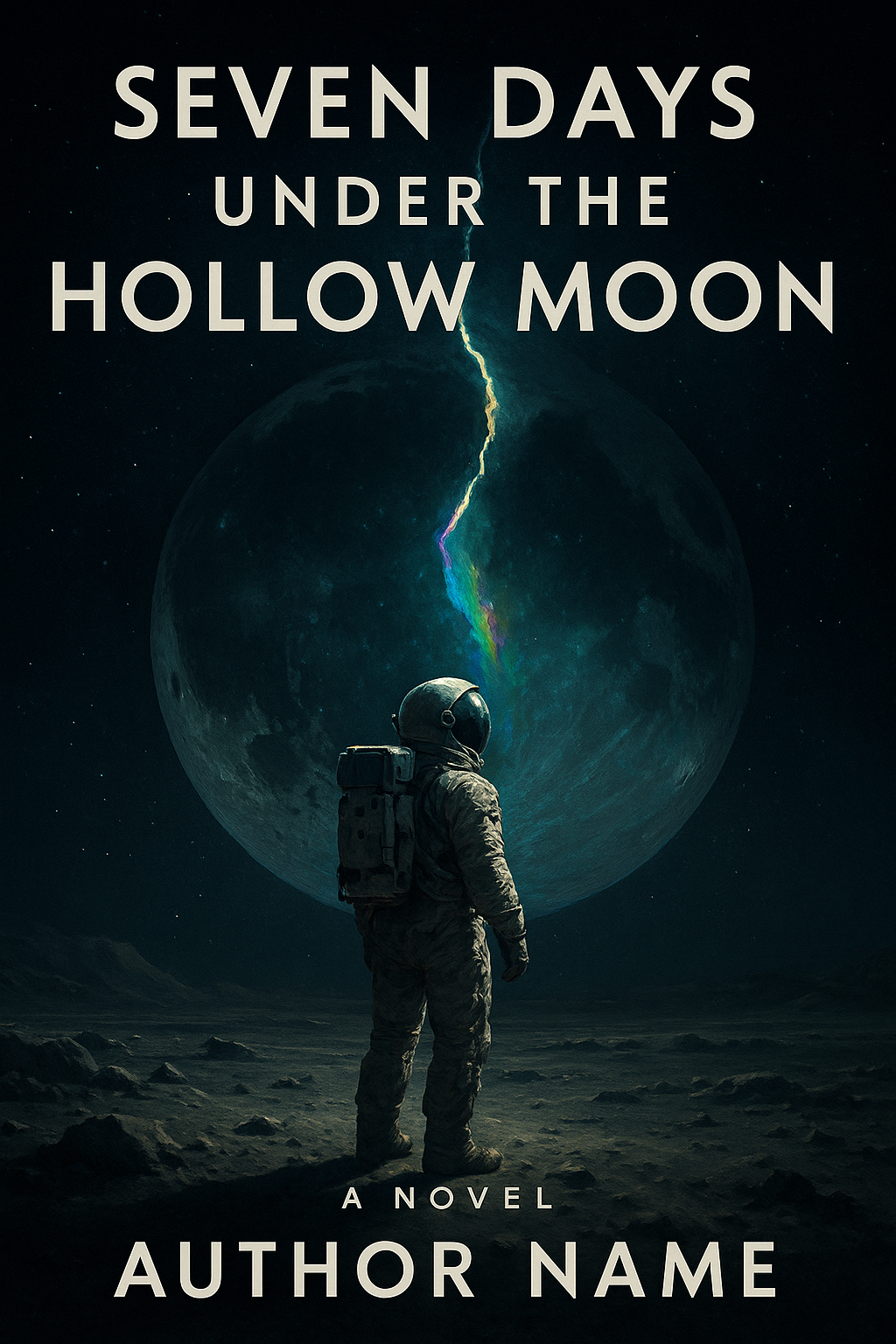
Elara Frost stood at the viewport of Artemis Lunar Base, her routine geological survey forgotten as she stared upward in disbelief. The moon—the very celestial body she had called home for the past fourteen months—was changing before her eyes.
"Commander Chen!" Her voice cracked over the comms. "Sir, you need to see this immediately."
Dr. Wei Chen arrived within minutes, breathless despite the lunar gravity. "What is it, Frost? The seismographs haven't—" His words died as he followed her gaze.
A fissure had appeared in the lunar sky—a jagged line of prismatic light cutting across the star field. Initially, Elara had thought it was an equipment malfunction or perhaps a stress-induced hallucination. Fourteen months of isolation could do strange things to the mind. But as Wei's expression morphed from confusion to astonishment, she knew this was real.
"That's... impossible," he whispered, adjusting his glasses with trembling hands.
"The geology team has been detecting microseismic activity for weeks, but nothing that would explain this," Elara explained, pulling up readings on her tablet. "And look—the fracture is emitting radiation in wavelengths we cannot even categorize."
Soon, all seven crew members of Artemis Base crowded the viewport. Wei Chen, the mission commander. Elara Frost, chief geologist. Dhanya Patel, structural engineer. Kofi Okafor, physicist. Sasha Volkova, communications specialist. Jun Takahashi, exobiologist. And Miguel Santos, medical officer and psychologist.
"Houston is going to think we have all gone insane," Sasha muttered, already drafting a report that would inevitably be met with disbelief.
"Not if we provide empirical evidence," Kofi countered, adjusting the observatory equipment to document the phenomenon.
As Earth rotated into view below them, a realization struck Elara with stunning clarity. "We have been thinking about this all wrong," she said slowly. "Look at the positioning. That is not a crack in space. It is a crack in the lunar surface. The moon itself is breaking open."
"That is even more impossible," Wei replied, but his scientific mind was already processing the implications. "Unless..."
"Unless the moon is not what we have always thought it was," Elara finished.
As darkness fell on their section of the lunar surface, the fissure glowed brighter, casting eerie blue-green light across the barren landscape. Thermal imaging showed the crack extending downward, not just along the surface. Something was changing beneath their feet.
"I think," Jun said quietly, "we are about to discover why the moon rings like a bell when struck."
Day Two: Descent
Mission Control's response was predictable. Skepticism, demands for more data, and strict orders to maintain regular operations while an expert team analyzed the situation from Earth. What they could not understand was the urgency. The fissure was widening by the hour, and something about its perfectly geometric edges suggested intention rather than natural phenomenon.
"They want us to sit tight for three weeks while they prep an extraction team," Miguel reported after the morning communication window closed. "Standard protocol for unprecedented lunar events."
Dhanya snorted, reviewing her structural scans for the fifth time. "The composition makes no sense. It is not any lunar material we have cataloged. It is responding to our presence—changing its molecular structure when we observe it."
"Command does not understand what we are dealing with," Kofi argued, pacing the narrow confines of the common area. "By the time their team arrives, this opportunity could be gone."
The seven gathered around the central table, a silent understanding passing between them. They had all left Earth knowing the risks of space exploration. Each had signed waivers acknowledging they might never return. But none had anticipated this particular choice.
"We came here to explore," Wei said finally, his usually conservative approach giving way to the scientist's fundamental drive: curiosity. "I say we explore."
They spent the rest of the day modifying their EVA suits for extended use and repurposing equipment into makeshift climbing gear. Elara and Dhanya, both experienced mountaineers on Earth, devised a system of anchors and safety lines.
As the Earth-day cycle ended, they gathered at the edge of the fissure three kilometers from base. The opening had widened to nearly forty meters across, revealing a sloping tunnel descending into darkness. But not complete darkness. Bioluminescent patches lined the walls, pulsing in slow, rhythmic patterns.
"Last chance to follow protocol," Wei offered, though his tone made clear his own decision was made.
Sasha adjusted her recording equipment. "History is happening beneath our feet. I am going."
One by one, they voiced their agreement.
"For what it is worth," Miguel added with a nervous laugh, "as the mission psychologist, I certify us all as displaying sound judgment under extraordinary circumstances."
Jun stepped to the edge, peering into the unknown. "Actual first contact might be waiting down there. I did not train my entire life to miss that."
They activated their suit lights, checked their tethers, and began their descent into the hollow moon.
Day Three: Labyrinth
The descent took them through a network of tunnels that defied conventional physics. Gravity shifted unpredictably—sometimes pulling at forty percent Earth-normal, sometimes at eighty, sometimes laterally along a corridor. The tunnels themselves appeared to reconfigure when not directly observed, creating a labyrinth that seemed intentionally designed to confuse.
"These walls..." Dhanya ran specialized instruments over the gleaming surfaces. "They are composed of elements we do not have on our periodic table. And they are warm—generating their own energy somehow."
The bioluminescence grew more pronounced the deeper they ventured, eventually providing enough light that they could conserve their suit power. The patterns no longer seemed random but organized into complex, flowing symbols.
"I think it is language," Sasha suggested, recording everything. "Or at least communication of some kind."
They discovered chambers branching off from the main passages, each more bewildering than the last. One contained suspended geometric objects that rotated in perfect synchronization despite having no visible mechanism. Another held what appeared to be three-dimensional star maps of systems none of them recognized.
"How long has this been here?" Miguel wondered aloud, his psychological training struggling to process what they were witnessing.
"The moon is 4.5 billion years old," Kofi replied, "but this... this could predate the Earth itself."
In what they designated as Chamber Seven, they found their first concrete evidence of intelligent design: a circular room with seven alcoves, each sized perfectly to accommodate one of their EVA suits. In the center stood a crystalline structure that hummed when they approached.
"It is responding to us," Jun observed. "As if it has been waiting."
Elara felt drawn to the crystal, experiencing a strange resonance she could not explain. When she stepped closer, images flooded her mind—stars dying, worlds burning, desperate journeys across vast distances.
"It is trying to communicate," she gasped, steadying herself against Wei's shoulder.
"We should establish a base camp here," Wei decided. "Our suits have twelve hours of life support remaining before we need to return to the surface."
As they set up their temporary shelter, none of them noticed how the entrance to Chamber Seven had subtly changed shape, or how the luminous patterns on the walls had begun to synchronize with their breathing patterns.
They were being watched. And studied. And measured.
Day Four: Contact
Elara woke from troubled dreams of astronomical catastrophe to find the chamber transformed. The walls now displayed what appeared to be Earth's history—from primordial oceans to dinosaurs to human civilization—rendered in flowing light patterns.
"They have been studying us," she realized, waking the others. "For millions of years."
As the team gathered to examine the changed environment, the central crystal pulsed brightly. From it emerged what they could only describe as intersections of light and shadow—entities that existed in more dimensions than the human eye could process.
Kofi's instruments went haywire. Jun nearly fainted. Sasha's recording equipment captured nothing but static.
"Non-physical intelligence," Wei breathed, instinctively backing away. "Or physical in ways we cannot comprehend."
The entities moved through solid matter as if it did not exist, communicated through modulations of light and vibrations felt through their suits. Direct verbal communication proved impossible, but patterns emerged—mathematical sequences that Kofi and Dhanya began to interpret.
"They are showing us prime numbers," Kofi explained, "then moving to binary representations, then to what I think are coordinates."
Hour by hour, rudimentary communication developed. The entities seemed just as fascinated by the humans as the humans were by them, studying their equipment and occasionally merging partially with their suits—an experience Miguel described as "having your mind gently examined."
By evening, they had established enough understanding for Elara to grasp fragments of the beings' purpose. When she slept again, the communication continued in her dreams—more vivid and coherent than before.
She saw a distant star system with twelve planets. She watched as its sun began to destabilize, witnessed civilizations far more advanced than humanity facing extinction. She felt their desperate plan form: to create vessels—moon-sized arks—and send them across the galaxy to suitable star systems. To hide in plain sight, disguised as natural satellites, observing and waiting.
When Elara woke, tears streamed down her face. "They are refugees," she told the others. "And they have chosen this moment to reveal themselves because they have detected something coming. Something that threatens Earth just as their world was once threatened."
Day Five: Revelation
The entities led them deeper into the hollow moon's core, to a vast spherical chamber that must have been kilometers across. Inside, a perfect representation of the solar system hung in space—planets rotating in real time, sun flaring with actual nuclear reactions, the asteroid belt shifting in its eternal dance.
But beyond their solar system, in a section of space that should not have been visible from their perspective, a distant stellar event was unfolding. A massive star was collapsing.
Wei studied the projection with growing horror. "That is a supernova in progress," he said. "In real astronomical terms, it already happened. The light just has not reached us yet."
"And when it does?" Miguel asked, though the dread in his voice suggested he already knew.
"Gamma-ray burst," Kofi whispered. "A concentrated beam of radiation that could strip Earth's atmosphere, destroy the ozone layer, trigger mass extinction."
Through their emerging communication system, the entities confirmed what the scientists feared. The burst was aimed directly at their solar system and would reach Earth within a century. Not tomorrow. Not next year. But soon enough that without preparation, human civilization would end.
"They have been watching us," Jun realized. "Waiting until we developed enough technology to understand both the threat and potential solutions."
The entities showed them more: simulations of what would happen to Earth without intervention. Oceans boiling, forests burning, the planet rendered uninhabitable. But they also showed alternatives: shield technologies, underground habitats, methods of deflection.
"They are offering to help us," Elara said with wonder. "They have seen civilizations fall before. They do not want to watch it happen again."
The central database—the crystalline structure they had first encountered—contained millennia of observations, technologies beyond human comprehension, and the collective knowledge of a species that had already survived what humanity now faced.
"Why now?" Sasha asked, the journalist in her still seeking the complete story. "Why not earlier, or later?"
The answer came in another vision: humanity at a crossroads. We had developed enough to understand the threat and potentially address it, but had not yet progressed enough to detect it on our own. We were in the precarious middle stage of technological adolescence—capable of self-destruction but also of tremendous growth. The entities had determined this precise moment as optimal for intervention.
As the team absorbed this revelation, Dhanya noticed something troubling about the lunar structure around them. "The fissure is beginning to close," she reported. "I am detecting the same seismic pattern that preceded its opening, but in reverse."
They had precious little time to decide what to do with this world-changing knowledge.
Day Six: Decision
Debate raged among the seven as they made their way back toward the surface. The responsibility they now carried was immense. Knowledge that could save humanity or, if mishandled, cause global panic and chaos.
"Command will not believe us," Miguel argued. "Not without proof. We will be quarantined, debriefed, probably diagnosed with space psychosis or mass hallucination."
"The recordings—" Sasha began.
"Show nothing conclusive," Kofi interrupted. "The entities do not appear properly on any of our equipment. We have readings of anomalous energy patterns, but nothing that screams 'intelligent alien life.'"
The crystal database, however, was tangible. The entities had provided it as a gift—or perhaps as their version of an emergency broadcast. It contained not just warnings but solutions: advanced physics, materials science, medical knowledge, energy technologies.
"We need to bring it back," Elara insisted. "Whatever the personal cost."
"And if governments weaponize it instead?" Wei countered. "If instead of building shelters, they build better bombs?"
Jun had been quietly analyzing samples collected from various chambers. "This technology... it is beyond nation-states. Beyond any single entity's ability to control. Once it is understood, it will transform everything."
"That is what I am afraid of," Wei replied.
As they neared the narrowing exit, they passed through a chamber they had not seen before—one that showed Earth's possible futures. In one, humanity fractured, fighting over resources as the gamma threat approached. In another, a unified response led to extraordinary advancement, with shield technologies protecting the planet and a transformed civilization emerging stronger.
"They are showing us potential," Dhanya observed. "Not certainty."
"Which means the choice is still ours," Elara concluded.
Throughout the day, they argued, calculated risks, considered alternatives. Could they bring proof without the database? Should they reveal everything at once or gradually prepare humanity? Was it their right to make this decision for the entire species?
As night fell and the fissure continued to narrow, they made their choice. Humanity deserved the chance to survive, whatever path that took.
"We bring the database," Wei finally agreed. "But we also bring something else. A message directly from the entities, if they will provide it. Something that explains their intentions clearly, that might unite rather than divide us."
The entities, sensing their decision, led them to a final chamber where they recorded a message—a combination of visual mathematics and universal principles that, while not a language in the human sense, conveyed a profound truth: that intelligence throughout the cosmos faced similar challenges, and that survival often depended on cooperation rather than competition.
"It is not just technology they are offering," Jun realized. "It is perspective."
Day Seven: Ascent
Dawn found them rushing toward the rapidly closing fissure, the valuable database secured in Elara's pack. The hollow moon was sealing itself—whether as protection or because its purpose in warning them was complete, they could not know.
The ascent proved far more treacherous than the descent. The shifting gravity worked against them now, and sections that had been stable three days earlier began collapsing. At one junction, a sudden structural shift separated Miguel and Sasha from the group.
"We will find another way up!" Sasha called through the narrowing gap. "The entities showed me alternative routes on the star map!"
"We will wait for you at the surface," Wei promised, though they all recognized the diminishing odds.
Hours later, as the remaining five neared the surface, the entire structure shuddered. The fissure had narrowed to barely five meters wide.
"We are not going to make it," Dhanya calculated, eyeing the closing gap.
"Yes, we are," Kofi countered, rigging their remaining climbing equipment into an improvised ascension system. "Because we have to."
They emerged into the lunar day one by one, the fissure now merely a crack in the surface. As Wei, the last one out, cleared the opening, they watched it seal completely, leaving no trace it had ever existed.
"Miguel and Sasha?" Jun asked, scanning the barren landscape.
As if in answer, their comms crackled to life. "We made it!" Miguel's voice, breathless but triumphant. "Different exit point, about two kilometers south of base. The entities... they guided us."
Relief washed over the team, followed quickly by the sobering weight of what came next. They gathered their equipment and began the trek back to Artemis Base, where a disbelieving Mission Control awaited their report.
"Will they come back?" Jun wondered, looking at the now-seamless lunar surface. "Will we see them again?"
"I think that depends on us," Elara replied, feeling the database pulse gently against her side. "On what we do with what they have given us."
Epilogue
As they approached the base, Elara paused to look at Earth hanging in the black sky. Beautiful. Vulnerable. Unaware of what approached or what had been discovered. Everything would change once they returned. Human history would forever be divided into before and after this revelation.
"We went looking for moon rocks," Kofi said with a wry smile, "and found the future of humanity instead."
"Seven days," Wei mused. "Seven days under the hollow moon to change the course of our species."
Dhanya adjusted her pack. "Let us just hope we are ready for what comes next."
The seven astronauts continued toward the base, their shadows stretching long across the lunar surface. Behind them, the moon kept its secrets once again, while the database they carried held the potential to unite humanity against extinction—or to send it spiraling into chaos.
Either way, the countdown had begun. And somewhere within the hollow moon, ancient observers waited to see what humanity would choose to become in the face of cosmic threat. Whether we would rise together or fall divided.
As Artemis Base came into view, Elara felt something unexpected growing within her. Hope. For the first time in human history, we had been given a glimpse beyond our cosmic isolation. We were not alone in the universe, and perhaps—just perhaps—we were worth saving.
The moon completed another rotation, silent guardian of both its hidden inhabitants and the fragile blue world it orbited. Seven days had changed everything, though the rest of humanity did not know it yet.
They soon would.
The views expressed in this article are those of the author and do not necessarily reflect the views of WriteFlow. WriteFlow does not endorse this content and does not guarantee its accuracy or completeness.




Comments (0)