How Climate Change Is Impacting Everyday Life in the US, Canada, and the UK

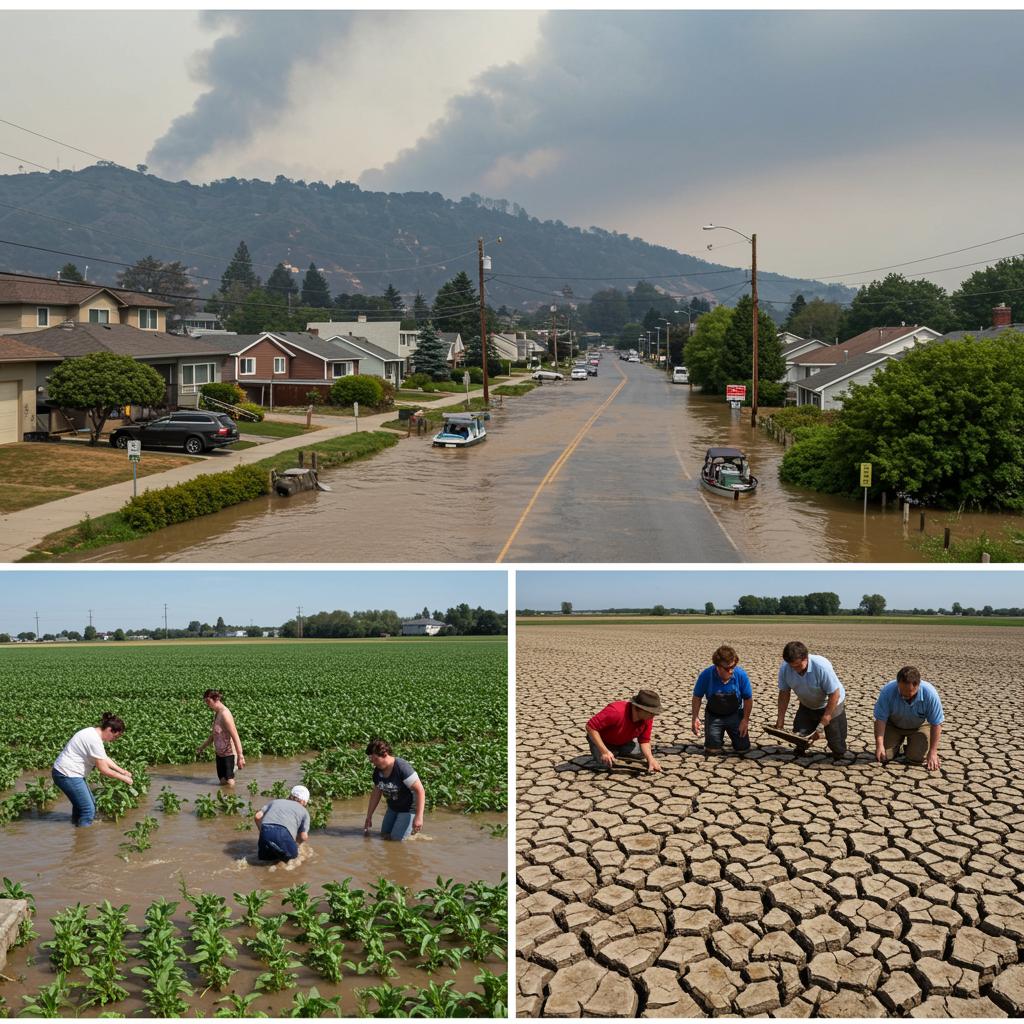
The New Normal: How Climate Change Is Quietly Rewriting Daily Life
The alarm clock that never rings, the garden that blooms in winter, the insurance bill that doubles overnight. Climate change has slipped into our daily routines with the stealth of a persistent house guest who quietly rearranges the furniture when we are not looking.
For decades, climate change remained an abstract concept for many—a distant threat discussed primarily in scientific journals and international summits. Today, that perception has shattered like ice under an unexpected spring thaw. Climate change has moved from the realm of future predictions to immediate reality, fundamentally altering daily life across North America and the United Kingdom in ways both subtle and profound. From the foods disappearing from local supermarkets to the insurance premiums that now rival mortgage payments, from seasonal allergies that never seem to end to weekend recreation choices dictated by air quality apps, the fingerprints of a changing climate are increasingly evident in the most ordinary moments of our lives.
This transformation unfolds not just in headline-grabbing disasters but in the quiet adjustments millions of citizens make as they adapt to new environmental realities. It is the Minnesota grandmother who can no longer rely on her family's century-old gardening wisdom. The Miami Beach host who checks tide tables before dinner parties. The British homeowner installing air conditioning in a country that once never needed it. These stories, multiplied across millions of households, reveal how climate change has already begun rewriting the social contract between humans and their environment.
When Spring Becomes a Stranger: America's Climate Contrasts
Eleanor Hanson stands in her Minneapolis garden, holding a packet of tulip bulbs her grandmother planted for seventy years. At sixty-seven, she has decided to break the family tradition. "Spring has become a stranger," she says, her voice carrying the weight of generational knowledge suddenly rendered obsolete. "It arrives like an unpredictable visitor. Sometimes in February, sometimes not until May. My grandmother's gardening calendar, passed down through four generations, has become a relic in my own lifetime."
This phenomenon—increasingly erratic seasonal transitions—represents perhaps the most universally experienced climate impact across American communities. The National Oceanic and Atmospheric Administration reports that spring now arrives eight to twenty days earlier across much of the continental United States compared to the mid-twentieth century, but it arrives with a chaos that makes planning impossible. The result is a cascade of disruptions that ripple through everything from agricultural planning to cultural traditions, from school schedules to suburban beautification efforts.
In Phoenix, Arizona, extreme heat has fundamentally transformed the rhythm of daily life in ways that would have seemed surreal to previous generations. Local schools have invested millions in revolutionary playground designs featuring elaborate shade structures and moisture-cooling systems, while regularly canceling outdoor recess during increasingly frequent days when temperatures exceed one hundred fifteen degrees Fahrenheit. That threshold once marked occasional extreme weather but now defines much of the summer experience. The city operates a network of cooling centers in libraries and community buildings that have become as essential as hospitals, while restaurants and cafés have shifted their business models from daytime to evening service during summer months, creating a nocturnal economy that emerges as the sun sets.
"We have become vampires," jokes Miguel Hernandez, a Phoenix resident and father of three, though his humor carries an edge of genuine concern. "Our kids' soccer league plays exclusively under stadium lights from May through September. Dog walking happens at dawn or dusk. Midday walks are literally dangerous. Even grocery shopping requires strategic planning around temperature forecasts. We are not just adapting to weather anymore. We are adapting our entire concept of when it is safe to be outside."
The real estate market tells its own story of climate adaptation, particularly in coastal Florida where climate gentrification has emerged as a defining economic force. Properties at higher elevations now command premiums that reflect their flood-protection value as much as their views, while entire neighborhoods in Miami-Dade County regularly experience sunny day flooding—a phenomenon so common it has its own vocabulary. This is not flooding from storms. It is seawater pushed up through storm drains during high tides, turning streets into temporary rivers under clear blue skies.
"I have learned to read tide tables the way previous generations read weather forecasts," explains Miami Beach resident Sophia Chen. "There are simply days when guests cannot reach my home without wading through saltwater that bubbles up from the pavement itself."
Local governments have responded with infrastructure investments that stagger the imagination. Billions are being spent on pumping systems, elevated roads, and modified drainage networks that represent a complete reimagining of how cities interact with water. These costs, ultimately borne by taxpayers through municipal bonds and increased fees, constitute what economists increasingly recognize as a climate tax embedded in the basic cost of urban living.
In California, the insurance market has become the front line of climate reality, with many residents reporting coverage non-renewals or premium increases exceeding three hundred percent in fire-prone areas. The California Department of Insurance reported that over 2.4 million homeowners now struggle to obtain affordable coverage due to wildfire risk. This crisis is rapidly spreading to other western states.
Warren Mills of Nevada County represents thousands of similar stories. "We have lived here for thirty years, never filing a claim, always paying premiums on time. Now we are paying nearly nine thousand dollars annually for coverage that is actually reduced from what we had before. It is effectively a climate tax that doubles every few years."
The changing American plate tells another story of adaptation and loss. Climate disruptions increasingly affect what Americans eat and how much they pay for it, with warming temperatures shifting agricultural zones in ways that would have seemed impossible to previous generations. Corn now grows commercially in parts of southern Alaska, while traditional farming regions face unprecedented challenges. In Michigan, cherry farmers have experienced five near-total crop failures between 2015 and 2024—devastating losses when early spring warmth prompts blossoms that subsequent freezes destroy. This represents a fundamental disruption to an industry that had operated predictably for over a century.
At grocery stores, consumers encounter subtler changes that collectively represent a transformation in American eating habits. Smaller produce sizes, new varieties bred for heat resistance rather than flavor, and price volatility that follows climate events with increasing predictability. Washington State's apple industry has gradually shifted toward varieties that better tolerate heat stress, while Florida orange juice prices have risen dramatically as citrus greening disease—exacerbated by warmer winters that allow disease-carrying insects to thrive year-round—decimates orchards that once seemed permanently productive.
"We are not just adapting what we grow and how we grow it," explains Dr. Ayana Mitchell, agricultural extension specialist at Michigan State University. "We are adapting the fundamental expectations Americans have about food availability and consistency. The era of seasonal abundance and variety that defined American eating for generations is ending. What comes next will require entirely new relationships between consumers and their food sources."
Health impacts extend far beyond the heat-related illnesses that dominate headlines. Allergists report longer, more intense pollen seasons that are creating new patients at unprecedented rates, with many people developing allergies later in life as pollen loads increase and seasons extend indefinitely. The ragweed pollen season now lasts twenty days longer in the central United States than in 1995, according to University of Maryland research, effectively eliminating the traditional allergy relief periods that allowed sensitive individuals to recover between seasons.
Vector-borne diseases previously limited to tropical regions continue their relentless march northward. Lyme disease cases have doubled since 2000, with disease-carrying ticks now established in areas previously too cold for their survival. Meanwhile, mosquito species capable of transmitting dengue fever and Zika virus have expanded their range into more than half of all states, bringing tropical diseases to temperate communities unprepared for such threats.
Mental health professionals increasingly recognize climate anxiety as a legitimate and growing concern, particularly among younger Americans who face the prospect of living their entire adult lives in a destabilizing climate. A 2024 American Psychological Association survey found that sixty-seven percent of Americans aged eighteen to thirty-four report experiencing anxiety related to climate change, with forty-one percent saying it affects their daily mood and major life decisions.
"What we are seeing isn't abstract worry about the future," explains Dr. Thomas Reynolds, a clinical psychologist specializing in environmental anxiety. "It is tangible grief about changes people witness in places they love, combined with paralyzing uncertainty about basic life decisions like where to live, whether to have children, or even whether long-term planning makes sense anymore."
The Rapidly Warming North: Canada's Accelerated Transformation
Canada faces a climate reality that defies easy comprehension. The country is warming at approximately twice the global average rate, with Arctic regions warming nearly three times faster than the global mean. This disproportionate warming creates changes that cascade through Canadian society with the force of a geological shift compressed into a human lifetime.
In Iqaluit, Nunavut, Inuit communities confront challenges that strike at the heart of cultural identity and survival knowledge passed down through millennia. Traditional hunting practices, refined over thousands of years to work with predictable ice conditions, now face chaos as ice becomes unreliable and dangerous.
"The knowledge passed down from elders about safe ice travel—knowledge that kept our people alive for generations—does not always apply anymore," explains Sara Kudlak, who coordinates a community program desperately documenting changing conditions. "We are developing new safety protocols using satellite imagery and GPS technology to supplement traditional knowledge that is becoming insufficient for survival."
These Arctic changes ripple southward with devastating effect. Prairie provinces experience increasingly volatile precipitation patterns that cycle between drought and flooding within single seasons, while Ontario and Quebec face more frequent freezing rain events, devastating ice storms, and summer heat waves that strain infrastructure designed for a fundamentally different climate.
Canada's northern infrastructure, much of it built on permafrost assumed to be permanently frozen, faces an existential crisis as that frozen ground thaws and destabilizes. In Yellowknife, Northwest Territories, building foundations shift and crack as the ground beneath them literally liquefies. In northern Quebec, sections of road become impassable as the substrate that supported them for decades suddenly loses structural integrity. The impact extends to southern infrastructure as well, with Toronto's stormwater system—designed for historical rainfall patterns—regularly failing during intense precipitation events that now exceed design capacity with alarming frequency. The city has initiated a $3.1 billion flood protection program that represents just one example of the massive infrastructure investments municipalities are making across the country.
"We are essentially rebuilding the physical foundation of Canadian civilization," explains Dr. James Morin of the Institute for Catastrophic Loss Reduction. "Much of Canada's housing, transportation, and utility systems were designed for a climate that no longer exists and will never return. The scale of adaptation required is comparable to building the country from scratch."
This rebuilding comes with staggering costs. The Federation of Canadian Municipalities estimates that municipalities need to invest an additional $5.3 billion annually just to adapt existing infrastructure to new climate realities—costs that ultimately flow to residents through taxes and utility rates that transform the basic economics of Canadian life.
For a nation whose identity intertwines deeply with outdoor activities and natural beauty, climate impacts on recreation cut particularly deep. In British Columbia, ski seasons have shortened by approximately three weeks since 1980, with low-elevation resorts increasingly dependent on artificial snow that provides a pale imitation of natural skiing conditions. Summer tourism suffers regular disruption from wildfire smoke events that can shroud popular destinations for weeks, creating an economy of uncertainty that makes planning impossible.
"We used to plan our summer camping trips in January, booking favorite sites months in advance," says Vancouver resident Michael Tran. "Now we make tentative reservations but do not commit until the week before, when we can check fire maps and air quality forecasts. Family traditions built around outdoor recreation are becoming impossible to maintain."
In Ontario, warming waters threaten cold-water fish species like lake trout and brook trout—staples of recreational fishing that define Canadian outdoor culture. The Ontario Federation of Anglers and Hunters reports that catch rates for these species have declined dramatically in southern lakes, while warm-water species like smallmouth bass expand their range northward, fundamentally altering the ecosystem relationships that supported traditional fishing practices.
Winter recreation faces particular devastation. Canada's iconic Rideau Canal Skateway in Ottawa, typically open fifty to sixty days each winter, was completely closed for the 2020-2021 season and has experienced increasingly shortened seasons that threaten winter tourism and local traditions. The sight of the canal remaining liquid through January, once unthinkable, has become increasingly common.
Canadian agriculture experiences contradictory impacts that complicate adaptation planning. Warming temperatures extend growing seasons in some regions, particularly in Prairie Provinces where corn and soybean cultivation has expanded significantly northward. However, these apparent benefits are often offset by increased drought risk and precipitation patterns so variable they make crop planning a gamble.
In southern Ontario's wine country, producers now successfully grow varieties previously considered too heat-dependent for the region. "Twenty years ago, growing Syrah here would have been impossible," explains vintner Gabriela Kowalski of Niagara Peninsula's Eastern Slope Vineyards. "Now it is becoming one of our signature wines, and we are experimenting with even more heat-loving varieties."
Yet these opportunities come with significant challenges. Pest species previously limited by cold winters now survive year-round, dramatically increasing pesticide requirements and costs. Extreme weather events—particularly hailstorms and unseasonable frosts—create more frequent and severe crop losses that can wipe out entire harvests despite longer growing seasons.
Islands of Uncertainty: The United Kingdom's Maritime Climate in Crisis
The United Kingdom's historically moderate maritime climate, the foundation of everything from agricultural cycles to cultural identity, is transforming into something unrecognizable and increasingly erratic. The contrast between recent weather extremes tells a story of climate whiplash. The UK experienced its hottest-ever recorded temperature of 40.3 degrees Celsius in July 2022, followed by its coldest March night in 2023, with temperatures plunging to minus 15.4 degrees Celsius in the Scottish Highlands. This volatility represents not just statistical extremes but a fundamental disruption to the rhythms that have defined British daily life for centuries.
This increased volatility disrupts everything from education to transportation. Schools implement heat policies previously unnecessary in the temperate climate, while infrastructure designed for moderate conditions fails catastrophically during extremes. The London Underground, lacking comprehensive air conditioning because it was never needed, now regularly exceeds 35 degrees Celsius during summer heatwaves, forcing service adjustments that ripple through the entire transport network.
"We have installed air conditioning in our Birmingham home, something virtually no one had when I was growing up," says Rajesh Patel, fifty-three. "It is no longer a luxury but increasingly essential for basic comfort and safety during what used to be considered normal summer weather."
The UK faces seemingly contradictory water challenges that highlight climate change's capacity for paradox. Increased flooding risk alongside more frequent drought conditions that can occur within the same year or even season. Extended winter rainfall saturates ground beyond its capacity, causing rivers to breach banks with increasing frequency, while hotter, drier summers strain water supply systems designed for the traditional British climate of moderate, consistent precipitation.
In Yorkshire, Sarah Mitchell describes her family's bewildering new normal. "We have received flood alerts three times in the past year, each requiring us to deploy flood barriers and move valuables upstairs in preparation for potential evacuation. Yet last summer, we also faced hosepipe bans and severe water restrictions for eight consecutive weeks. We are simultaneously preparing for too much water and not enough, sometimes within the same month."
These contradictory conditions strain UK water infrastructure, much of which dates to the Victorian era and was designed for climate patterns that no longer exist. Water companies face mounting criticism for failing to reduce leakage rates that waste approximately twenty percent of treated water while simultaneously imposing increasingly strict usage restrictions during dry periods. The Environment Agency projects that without significant infrastructure investment and fundamental behavioral changes, many parts of England will face severe water deficits by 2045—a startling projection for a nation historically defined by abundant rainfall and lush green landscapes.
Perhaps nowhere is climate change more immediately visible to ordinary Britons than in their gardens and parks—spaces that have served as symbols of British culture and identity for centuries. The Royal Horticultural Society has revised its plant hardiness zones multiple times in recent decades, with Mediterranean species now thriving in southern England where they once would have died in winter.
"My grandmother grew traditional English cottage garden plants—delphiniums, lupines, phlox—that defined the British garden aesthetic," explains hobby gardener Emma Westbrook of Devon. "I have had to replace most of these with drought-tolerant Mediterranean alternatives as they simply cannot survive our increasingly hot, dry summers. It is like watching the English garden tradition die plant by plant."
Public gardens and parks implement similar transformations out of necessity. The Royal Parks of London have dramatically increased drought-tolerant plantings while reducing water-intensive flowerbeds that once defined British landscape design. The National Trust reports that many historic gardens now require fundamental modification to survive changing conditions, raising profound questions about preserving cultural heritage in a changing climate.
The iconic English lawn—a cultural symbol maintained for centuries and exported globally as an ideal of landscape beauty—faces an existential crisis. "The perfectly manicured green lawn is becoming environmentally untenable across much of southern England," explains Dr. Marcus Fellowes, landscape historian at the University of Reading. "We are witnessing a cultural shift toward alternative ground covers and more naturalistic, meadow-style landscapes that would have been considered unkempt by previous generations but are now necessary for sustainability."
British agriculture experiences complex changes that challenge traditional food production and cultural identity. Warmer temperatures enable new crops while increasing vulnerability to extreme events that can destroy harvests overnight. English wine production has expanded dramatically, with sparkling wines from Sussex and Kent now competing successfully in international markets. Crops like maize have become viable across much of the country, while producers experiment with heat-loving vegetables previously impossible to grow commercially.
However, traditional British crops face mounting challenges. Potato cultivation, absolutely central to British food culture and identity, struggles with increased summer drought and heat stress that can devastate yields. The James Hutton Institute projects that without significant adaptation, potato yields could decline by up to thirty percent in parts of eastern England by 2040, threatening both food security and cultural traditions built around this staple crop.
These agricultural changes gradually influence British diets in ways both subtle and profound. "Locally grown produce increasingly resembles what you would historically find in southern Europe rather than traditional British fare," notes food writer Charlotte Murray. "British asparagus season starts weeks earlier, strawberries are available from May through October, and you are seeing more locally grown aubergines, sweet peppers, and even apricots in farmers' markets. The traditional British seasonal eating calendar is being completely rewritten."
Seafood availability shifts as North Sea waters warm beyond the tolerance of traditional species. Cold-water fish like cod move northward toward Arctic waters, while warmth-preferring species like red mullet and anchovies become increasingly common in British waters and subsequently on British plates. This represents not just an economic shift but a cultural one, as fish and chips—the quintessential British meal—faces uncertainty about its core ingredient.
Global Connections, Local Disruptions
While each nation experiences distinct local impacts, their challenges interconnect through global systems in ways that make isolated adaptation impossible. California wildfire smoke now regularly drifts thousands of miles into Canadian cities, affecting air quality and public health across international borders. Shifting agricultural zones in North America influence food prices in British supermarkets, while British weather patterns increasingly affect European agriculture. Melting Arctic ice, accelerated by Canadian warming, contributes to changing precipitation patterns across all three nations through complex atmospheric interactions that scientists are still working to understand.
These interconnections extend to human migrations that are reshaping demographics and politics. Climate refugees from regions experiencing more severe impacts increasingly seek resettlement in temperate nations, contributing to population shifts within the United States, Canada, and the United Kingdom. The World Bank estimates that without adequate climate action, over 140 million people could become climate migrants by 2050, with profound implications for immigration policies, social services, and cultural identity in destination countries.
Economic systems further link national experiences through global markets that amplify local climate impacts. Insurance markets, increasingly stressed by climate-related claims, raise premiums across all three countries regardless of local risk levels. The reinsurance giant Swiss Re reported that climate-related insurance losses have increased by approximately 250 percent over the past decade, with costs ultimately passed to consumers worldwide through higher premiums that constitute a global climate tax.
Seeds of Resilience: How Communities Fight Back
Amid these mounting challenges, communities across all three nations demonstrate remarkable adaptability and innovation that offers hope for large-scale transformation. In British Columbia, the city of Victoria has pioneered urban design that integrates heat emergency response features throughout the cityscape. Expanded tree canopy, public misting stations, reflective pavement materials, and cool-roof requirements for new construction collectively reduce urban heat island effects while maintaining livability.
In southwest England, the town of Pickering rejected expensive engineered flood defenses in favor of nature-based solutions that work with natural systems rather than against them. By planting trees upstream, restoring wetlands, and implementing small-scale water retention features throughout the watershed, the community has successfully prevented flooding while simultaneously enhancing biodiversity and creating recreational opportunities that improve quality of life.
In Louisville, Kentucky, the nonprofit Louisville Grows has established an ambitious urban canopy program that specifically targets neighborhoods experiencing disproportionate heat impacts due to lack of tree cover. "We are planting trees today for the climate conditions of 2050," explains program director Malik Johnson. "Every tree we plant is an investment in future livability and a recognition that adaptation requires thinking beyond immediate needs."
These community-level adaptations often prove more nimble and effective than national responses, demonstrating pathways toward greater resilience that frequently outpace larger institutional changes. Local innovations—from neighborhood emergency response networks to community-owned renewable energy projects—create models for climate adaptation that connect directly to people's immediate concerns and daily experiences.
"Climate adaptation happens most effectively when it addresses people's immediate quality of life concerns while building long-term resilience," observes Dr. Maria Santos, director of the Community Climate Resilience Institute. "The most successful programs combine practical solutions to current problems with preparation for future challenges, creating buy-in through immediate benefits while building capacity for larger transformations."
The Quiet Revolution in Our Backyards
As this exploration reveals, climate change is not arriving as a future threat. It is already here, quietly rewriting the rules of daily life across North America and the United Kingdom. From the Minnesota grandmother abandoning family gardening traditions to the British homeowner installing air conditioning, from the Phoenix father scheduling his children's lives around temperature forecasts to the Canadian community developing new safety protocols for ice travel, millions of people are adapting to environmental changes that would have seemed impossible to previous generations.
These individual adaptations, multiplied across communities and nations, represent humanity's first attempts to live with climate change rather than simply discuss it. They reveal both our remarkable capacity for adaptation and the profound challenges that lie ahead as these changes accelerate and intensify. The question is no longer whether climate change will affect daily life, but how quickly and effectively we can adapt our communities, economies, and cultures to thrive in the new climate reality that is already upon us.
The future of daily life in a changing climate will be written not in international summits or scientific reports, but in the millions of small decisions people make as they adapt to their changing environment. Understanding these adaptations—learning from both their successes and failures—may be our best guide for navigating the more dramatic changes that lie ahead.
The views expressed in this article are those of the author and do not necessarily reflect the views of WriteFlow. WriteFlow does not endorse this content and does not guarantee its accuracy or completeness.

Comments (0)