Comeback Kings: The Greatest Returns in Sports History

Introduction
Sports history is filled with moments that defy logic, challenge probability, and remind us why we fall in love with competition in the first place. These are the stories that transcend mere athletic achievement and become part of our collective human narrative about perseverance, hope, and the extraordinary power of refusing to surrender. From individual athletes rising from the depths of personal and professional despair to entire teams orchestrating impossible turnarounds that rewrite the record books, the greatest comebacks in sports serve as powerful metaphors for resilience in all aspects of life.
The psychology of a comeback is as fascinating as it is inspiring. It requires a rare combination of mental toughness, unwavering belief, and the ability to perform under maximum pressure when conventional wisdom suggests that hope is lost. These moments reveal the true character of champions, stripping away pretense and exposing the raw determination that separates the extraordinary from the merely talented. Whether measured in minutes, months, or years, the greatest comebacks share common threads: preparation meeting opportunity, skill combining with fortune, and individuals or teams finding something extra when everything appears to be against them.
What makes these stories universally compelling is their ability to remind us that no deficit is truly insurmountable, no setback permanently defining, and no dream beyond the realm of possibility. They inspire us to reconsider our own limitations and challenge us to persist when our own circumstances seem overwhelming. The greatest comeback stories in sports history are ultimately human stories about the triumph of spirit over circumstance, proving that sometimes the most beautiful victories come from the deepest valleys of defeat.
Tiger Woods: The Ultimate Redemption
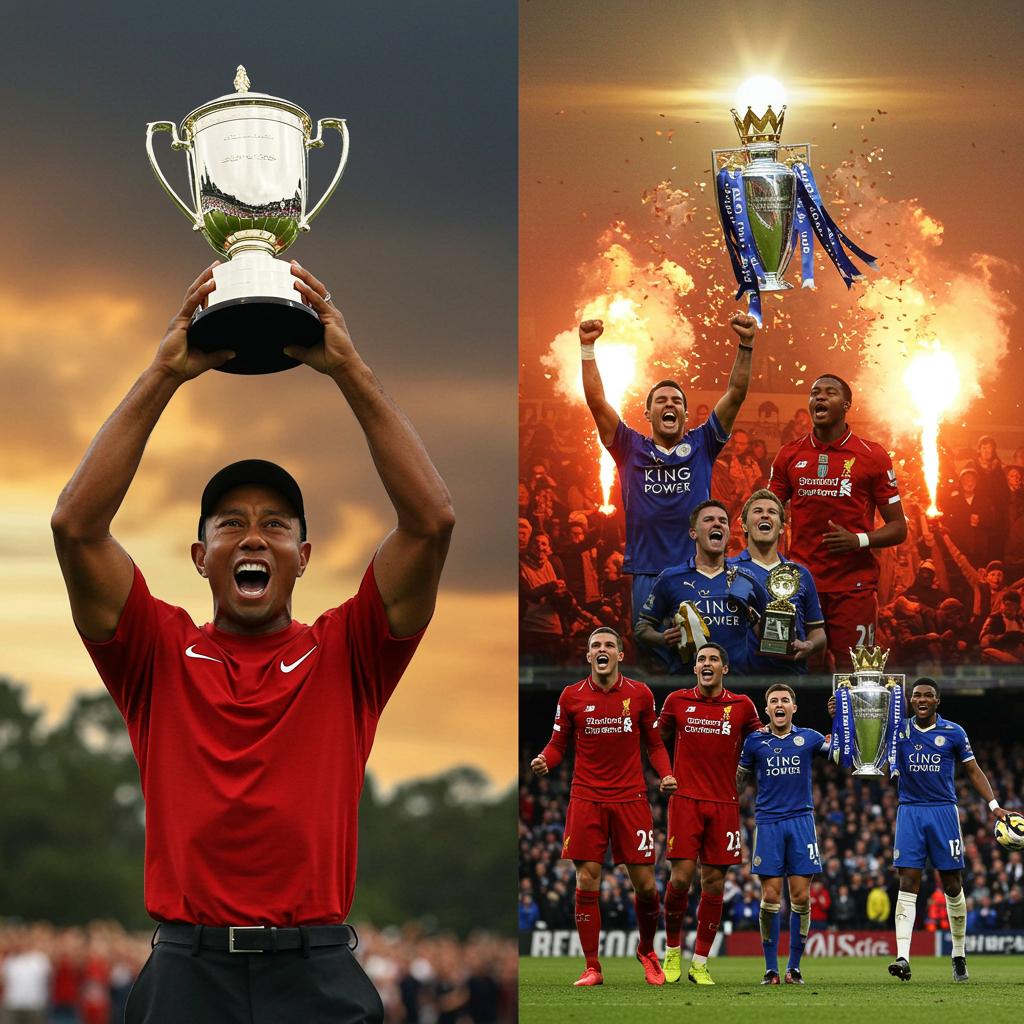
The most thrilling comeback in modern sports history had to be completed at Augusta, at the Masters, on a Sunday afternoon in April, when Tiger Woods captured his fifth Masters title in 2019 after an eleven-year major championship drought. Woods' journey back to glory represents perhaps the most compelling individual comeback in sports history, encompassing not just athletic decline and resurrection but personal scandal, physical breakdown, and psychological reconstruction—all playing out under the unforgiving spotlight of global media scrutiny.
The depths of Woods' fall from grace seemed to make his return impossible. Personal scandals in 2009 destroyed his marriage and tarnished his reputation, while a series of back surgeries left him barely able to walk, let alone compete at golf's highest level. Only eighteen months before his win, Woods could barely move. Medical experts questioned whether he would ever play competitive golf again, and many assumed his legendary career was effectively over.
The 2019 Masters victory was more than just another tournament win. It was validation that human determination can overcome seemingly insurmountable obstacles. Woods' methodical climb back to relevance required not just physical rehabilitation but complete psychological reconstruction. He had to rebuild his swing, regain his confidence, and prove to himself and the world that he could still compete with players who had grown up idolizing him. The roar that erupted at Augusta National when he sank his final putt represented eleven years of frustration, doubt, and persistent hope finally being rewarded.
Woods' comeback resonated far beyond golf because it addressed universal themes of redemption, second chances, and the possibility of reclaiming lost greatness. His story proved that even the most devastating setbacks need not be permanent, and that proper preparation and unwavering determination can restore what seemed permanently lost. The sight of his children watching him win his first major championship in their lifetime added an emotional dimension that transformed athletic achievement into a profound human moment about legacy, family, and the enduring power of perseverance.
Liverpool's Miracle at Anfield: Overcoming the Impossible
Liverpool's 4-0 comeback against Barcelona in the 2019 Champions League semifinals is widely regarded as one of football's most improbable turnarounds. Trailing 3-0 after the first leg at Camp Nou, Liverpool faced the daunting task of overcoming a Barcelona team featuring Lionel Messi at his peak—a challenge that appeared mathematically possible but practically impossible.
The magnitude of Liverpool's task became clear when considering Barcelona's away record and their experience in managing substantial leads in high-pressure situations. The Catalans had arguably the world's best player, a roster filled with Champions League winners, and the confidence that comes from having navigated countless pressure situations successfully. Liverpool, meanwhile, were missing key players Mohamed Salah and Roberto Firmino due to injury, leaving them without two of their most creative and prolific attackers for the most important match in recent club history.
What transpired at Anfield on May 7, 2019, defied every statistical model and tactical analysis. Liverpool booked their place in the final after producing a miracle comeback, winning 4-0 at Anfield to complete a 4-3 aggregate victory. Goals from Divock Origi and Georginio Wijnaldum completed a turnaround that seemed impossible at halftime of the first leg. The Anfield atmosphere became a tangible factor, with the crowd's energy seemingly lifting players to performance levels that exceeded their individual capabilities.
The tactical brilliance of the comeback lay in Liverpool's relentless pressing and Barcelona's inability to cope with the physical and psychological pressure. Jürgen Klopp's team created an environment where Barcelona's technical superiority became a liability, forcing errors from players who rarely made mistakes in less intense situations. The fourth goal, scored from a quickly taken corner kick while Barcelona's defense was still organizing, epitomized the intelligence and opportunism that characterizes the greatest comeback performances.
Leicester City: Defying Mathematical Impossibility
Leicester City's 2015-16 Premier League triumph remains the most statistically improbable championship in modern sports history—a feat that transcended football and became a global symbol of hope for underdogs everywhere. Starting the season with five-thousand-to-one odds to win the Premier League, Leicester's story combines individual brilliance, tactical innovation, team chemistry, and perfect timing in a way that may never be replicated in professional sports.
The Foxes had barely avoided relegation the previous season and possessed a roster assembled for a fraction of the cost of their competitors' squads. Players like Jamie Vardy, Riyad Mahrez, and N'Golo Kanté were relative unknowns who transformed into world-class performers under Claudio Ranieri's management. The team's success came not from individual superstars but from collective understanding, work ethic, and tactical discipline that maximized each player's strengths while minimizing weaknesses.
What made Leicester's achievement historically significant was its timing within the context of modern football's financial landscape. The Premier League had become increasingly dominated by wealthy clubs with massive transfer budgets and global scouting networks. Leicester's triumph proved that tactical intelligence, team cohesion, and perfect timing could still overcome financial disadvantages, at least for one magical season. Their counter-attacking style was perfectly suited to exploit the aggressive, high-pressing approaches favored by their more expensive competitors.
The psychological impact of Leicester's achievement extended far beyond football, inspiring countless stories about overcoming overwhelming odds through preparation, teamwork, and unwavering belief. Their success became a metaphor for possibility in an era when many sports had become predictable due to financial inequalities. The sight of Leicester players celebrating with the Premier League trophy represented a victory for romantic idealism over cynical realism, proving that fairy tales could still unfold in professional sports.
The Miracle of Istanbul: Liverpool's Champions League Resurrection
The 2005 Champions League final between Liverpool and AC Milan stands as perhaps the greatest comeback in football history, a match that redefined what was possible in elite-level competition. Liverpool entered halftime trailing 3-0 to a Milan team widely considered one of the greatest club sides ever assembled, featuring players like Kaká, Paolo Maldini, Andrea Pirlo, and Andriy Shevchenko at the peak of their powers.
The statistical impossibility of Liverpool's situation cannot be overstated. No team had ever overturned a three-goal deficit in a Champions League final, and Milan's experience and quality seemed to guarantee that this precedent would continue. The Italian giants controlled every aspect of the first half, scoring three goals in just six minutes and appearing destined for a comfortable victory.
Liverpool's second-half transformation remains one of sport's most analyzed and celebrated turnarounds. Steven Gerrard's header in the 54th minute provided the spark that ignited one of the most remarkable six-minute periods in football history. Vladimír Šmicer and Xabi Alonso quickly followed with goals that leveled the match and completely shifted the psychological momentum. The Atatürk Olympic Stadium became a cauldron of disbelief as Liverpool's supporters witnessed their team accomplish the impossible.
The penalty shootout that followed represented the perfect culmination of Liverpool's miraculous evening. Jerzy Dudek's double save from Andriy Shevchenko provided the heroic moment that sealed Liverpool's victory and completed one of sport's greatest individual and collective performances under pressure. The image of Liverpool players celebrating with the Champions League trophy after such an improbable turnaround became symbolic of football's capacity to produce moments that transcend sport and enter the realm of legend.
New England Patriots: The Greatest Super Bowl Comeback
Super Bowl LI will forever be remembered as the night Tom Brady and the New England Patriots orchestrated the greatest comeback in Super Bowl history, overturning a 28-3 deficit against the Atlanta Falcons to win 34-28 in overtime. The magnitude of this comeback extends beyond mere statistics, encompassing psychological pressure, historical precedent, and the individual brilliance required to perform under maximum scrutiny.
The Patriots' situation appeared hopeless entering the fourth quarter. No team had ever overcome a deficit larger than ten points in Super Bowl history, and the Falcons possessed one of the NFL's most explosive offenses, capable of scoring quickly and efficiently. Atlanta's lead seemed secure not just because of the point differential but because of the consistent dominance they had displayed throughout the game's first three quarters.
Brady's performance in orchestrating the comeback represents one of the greatest individual efforts in championship history. His ability to maintain composure, make precise throws under pressure, and lead his teammates through the most challenging circumstances of their careers demonstrated why he is considered among the greatest competitors in any sport. The Patriots' systematic dismantling of the Falcons' defense in the final seventeen minutes showcased not just individual brilliance but collective mental toughness that separated champions from merely talented teams.
The psychological impact of the Patriots' victory resonated throughout the NFL and beyond, proving that no lead is safe against truly elite competitors. The comeback required perfect execution in every phase of the game, from Brady's passing to the defense's crucial stops to the special teams' consistent performance. The sight of Patriots players celebrating their fifth Super Bowl title after such an improbable turnaround reinforced the franchise's reputation for excellence under pressure and Brady's status as a clutch performer.
Michael Jordan's Return: Basketball's Greatest Resurrection
Michael Jordan's return to basketball in 1995 after his brief baseball career represents one of sports' most compelling comeback narratives, combining personal reinvention with athletic excellence at the highest level. Jordan's decision to retire at the peak of his powers following the Chicago Bulls' third consecutive championship created a void in basketball that no other player could fill. His subsequent attempt to play professional baseball was widely seen as either admirable or foolish, depending on one's perspective.
The circumstances surrounding Jordan's return were unprecedented in professional sports. He had retired as the undisputed best player in the world, walked away from millions of dollars in salary, and spent nearly two years attempting to master a completely different sport. His decision to return to basketball came with enormous expectations and intense scrutiny about whether he could reclaim his previous level of dominance after such an extended absence.
Jordan's initial games following his return showed understandable rust and timing issues, leading some commentators to suggest that his legendary career might end on a disappointing note. However, the 1995-96 season demonstrated that Jordan's competitive fire and basketball instincts remained intact. The Bulls won a record seventy-two games during the regular season and captured the first of three additional championships, proving that Jordan's brief retirement had not diminished his ability to perform at basketball's highest level.
The psychological dimension of Jordan's comeback extended beyond individual achievement to encompass themes of personal fulfillment, risk-taking, and the pursuit of excellence in multiple arenas. His willingness to fail publicly in baseball demonstrated a vulnerability that made his basketball success even more remarkable. The image of Jordan celebrating his fourth championship after returning from retirement became symbolic of the possibility of reclaiming greatness even after walking away from it voluntarily.
Muhammad Ali: The Champion's Return from Exile
Muhammad Ali's comeback from his three-and-a-half-year exile from boxing represents one of the most politically and athletically significant returns in sports history. Ali's refusal to serve in the Vietnam War led to his boxing license being revoked and his heavyweight title being stripped during what should have been the prime years of his career. His return to boxing in 1970 came with questions about whether he could reclaim his previous dominance after such an extended layoff.
The significance of Ali's comeback extended far beyond boxing, encompassing issues of civil rights, political protest, and personal conviction that made his athletic achievements inseparable from larger social movements. His willingness to sacrifice his career for his principles created a narrative that elevated his eventual return to legendary status. The legal and social battles he fought during his exile added layers of meaning to every victory he achieved following his return.
Ali's performance in his return fights demonstrated that his skills remained largely intact despite the forced layoff. His victories over Jerry Quarry and Oscar Bonavena proved that he could still compete at boxing's highest level, setting up the epic trilogy with Joe Frazier and his eventual reclaiming of the heavyweight championship. The "Rumble in the Jungle" victory over George Foreman in 1974 represented the pinnacle of Ali's comeback, proving that he could still defeat the world's most feared heavyweight when conventional wisdom suggested his best days were behind him.
The cultural impact of Ali's comeback resonated far beyond sports, inspiring countless individuals who faced their own struggles against institutional opposition or personal setbacks. His ability to reclaim his championship while maintaining his political convictions demonstrated that athletic excellence and social consciousness could coexist successfully. The sight of Ali celebrating his victory over Foreman in Zaire became an iconic image of triumph over adversity.
The Psychology of Impossible Comebacks
The mental framework required to orchestrate historic comebacks involves a unique combination of psychological traits that distinguish elite performers from those who cannot perform under extreme pressure. Research in sports psychology has identified several key factors that enable athletes and teams to overcome overwhelming deficits. These include the ability to compartmentalize pressure, maintain focus on controllable factors, and sustain belief even when statistical evidence suggests futility.
The role of preparation in enabling comebacks cannot be overstated. The greatest comeback performances typically involve athletes or teams who have repeatedly practiced scenarios similar to their challenging situations, developing muscle memory and decision-making patterns that function automatically under pressure. This preparation creates confidence that transcends rational analysis, allowing performers to execute complex strategies when their conscious minds might be overwhelmed by the magnitude of their circumstances.
Team dynamics play a crucial role in collective comeback achievements. Successful turnarounds often feature individuals who can maintain group cohesion and focus when natural human tendencies would favor panic or resignation. Leadership during comeback situations requires the ability to communicate clearly, make decisive adjustments, and project confidence even when personal doubts may exist. The greatest team comebacks typically feature multiple individuals taking leadership roles at different moments, creating redundancy that prevents any single person's struggles from derailing the collective effort.
Lessons from the Comeback Kings
The greatest comeback stories in sports history offer profound lessons that extend far beyond athletics. They teach us that deficits, whether measured on a scoreboard or in the circumstances of our own lives, need not be permanent. They demonstrate that preparation, belief, and the willingness to persist in the face of overwhelming odds can produce results that seem impossible to rational analysis.
Perhaps most importantly, these stories remind us that our greatest moments often emerge from our deepest struggles. The athletes and teams celebrated in this article did not achieve greatness despite their challenges but because of how they responded to them. Their comebacks became defining chapters in their legacies, proving that how we respond to adversity reveals more about our character than how we perform when circumstances are favorable.
As we face our own challenges and setbacks, these stories offer both inspiration and instruction. They remind us that no deficit is truly insurmountable for those who refuse to surrender, and that the most beautiful victories often come from the deepest valleys of defeat.
The views expressed in this article are those of the author and do not necessarily reflect the views of WriteFlow. WriteFlow does not endorse this content and does not guarantee its accuracy or completeness.



Comments (0)