From London to Los Angeles: The Evolution of Modern Organized Crime

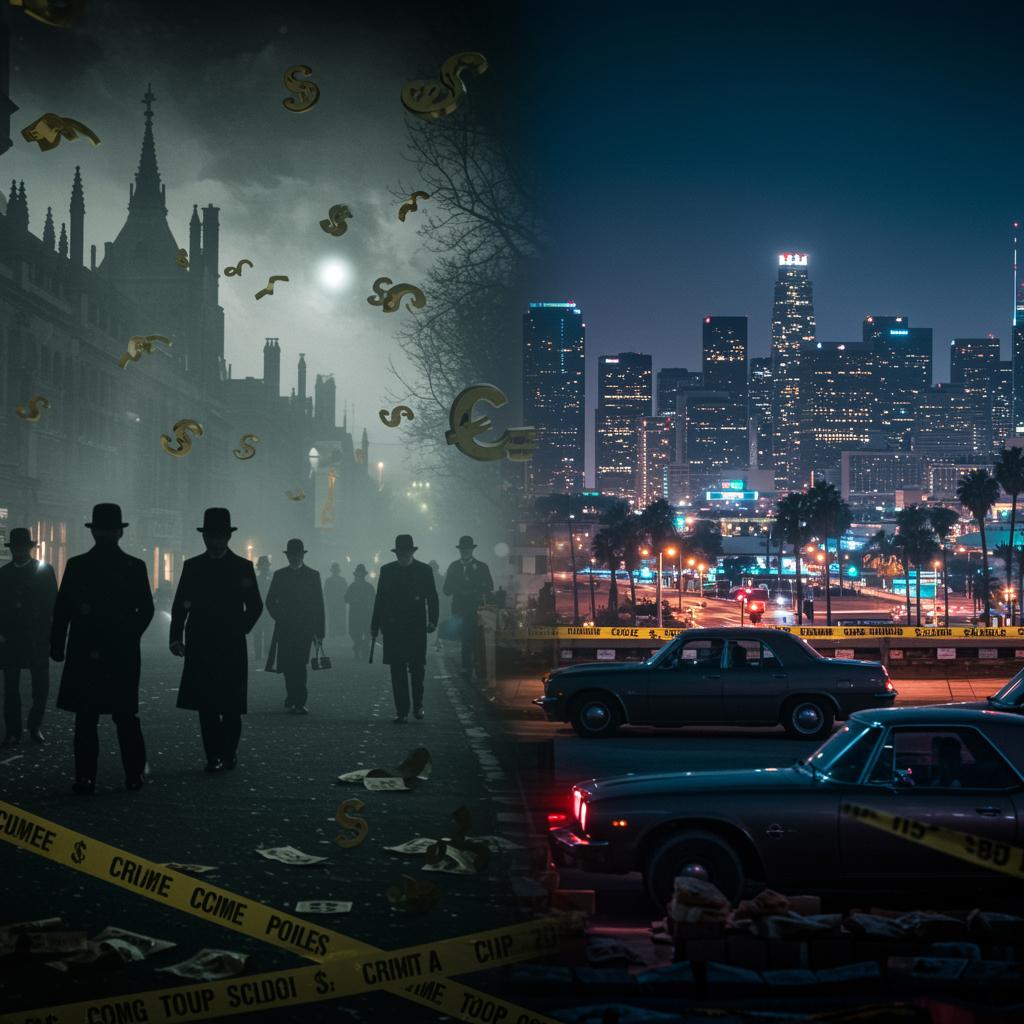
The transformation of organized crime from the fog-shrouded streets of Victorian London to the sun-drenched boulevards of modern Los Angeles represents one of the most fascinating evolutions in criminal enterprise history. This journey across continents and centuries reveals how criminal organizations have adapted, evolved, and internationalized, becoming sophisticated networks that rival legitimate multinational corporations in their complexity and reach. The London Genesis: Foundations of Modern Criminal Enterprise The roots of modern organized crime can be traced to 19th century London, where industrialization and urbanization created perfect conditions for criminal enterprises to flourish. The rapid growth of London's population, combined with inadequate policing and extreme social inequality, gave birth to organized criminal networks that would establish templates still used today. The Thames became a highway for smugglers, while the narrow alleyways of East London harbored protection rackets, illegal gambling operations, and sophisticated theft rings. During this period, criminal organizations began developing hierarchical structures that distinguished them from simple street gangs. The concept of territorial control emerged as groups carved up London's districts, establishing exclusive rights to various illegal activities within their domains. These early criminal enterprises understood the importance of corruption, systematically bribing dock workers, police constables, and local officials to ensure their operations remained protected. The development of specialized roles within these organizations—from enforcers to accountants to political fixers—laid the groundwork for the sophisticated criminal enterprises that would later emerge across the Atlantic. The Victorian era also saw the birth of what we now recognize as money laundering, as criminal organizations sought to legitimize their ill-gotten gains through seemingly respectable businesses. Pawnshops, taverns, and shipping companies became fronts for criminal operations, establishing a pattern of using legitimate enterprises to mask illegal activities that remains central to organized crime today. The international nature of London's port economy also introduced criminal organizations to the possibilities of cross-border operations, as they began coordinating with criminal elements in other European cities and eventually across the ocean. The Atlantic Crossing: Criminal Networks Go Global The late 19th and early 20th centuries witnessed a massive migration of people from Europe to America, and among these immigrants were individuals with knowledge of and connections to European criminal enterprises. This migration created the first truly international criminal networks, as established criminal organizations in London and other European cities began extending their operations to American shores. The crossing wasn't merely geographical but represented a fundamental shift in the scale and ambition of organized crime. Italian criminal organizations, including early iterations of what would become known as the Mafia, established footholds in American cities while maintaining connections to their European counterparts. Similarly, Irish criminal networks, many with roots in London's underworld, found new opportunities in American cities with large Irish immigrant populations. These transatlantic connections enabled criminal organizations to engage in international smuggling operations, moving goods, people, and money across borders with increasing sophistication. The development of modern communications technology, including the telegraph and eventually the telephone, revolutionized criminal coordination capabilities. Criminal organizations could now communicate across vast distances, coordinating complex operations that spanned multiple cities and countries. This technological advantage, combined with their international networks, gave organized crime groups significant advantages over law enforcement agencies that remained largely local and disconnected from their international counterparts. Prohibition: The Great Catalyst The implementation of Prohibition in the United States in 1920 created the most significant catalyst for organized crime evolution in modern history. What began as a moral crusade against alcohol consumption instead created the largest black market in human history, providing criminal organizations with unprecedented opportunities for growth and sophistication. The demand for illegal alcohol was so vast and the profits so enormous that criminal organizations transformed from relatively small local operations into major enterprises with national reach. During Prohibition, criminal organizations developed supply chains that stretched from international suppliers to local distributors, creating complex networks that required sophisticated management and coordination. They established relationships with corrupt officials at every level of government, from local police to federal agents, creating protection networks that enabled large-scale operations. The violence associated with territorial disputes during this period also led to the development of more sophisticated enforcement mechanisms and the emergence of criminal organizations as quasi-governmental entities in certain neighborhoods and cities. The end of Prohibition in 1933 forced criminal organizations to diversify their operations, leading to expansion into gambling, labor racketeering, and various forms of illegal lending. This diversification required even greater organizational sophistication and led to the development of the modern criminal enterprise model, where organizations operate multiple illegal businesses simultaneously while maintaining extensive legitimate business interests as both cover and additional revenue sources. The Hollywood Connection: Crime Moves West The growth of Los Angeles in the mid-20th century, fueled by the entertainment industry and post-war economic expansion, created new opportunities for organized crime operations. Unlike the established criminal territories of East Coast cities, Los Angeles represented fresh territory where criminal organizations could establish operations without confronting entrenched rivals. The entertainment industry, with its cash-intensive nature and connections to gambling and nightlife, proved particularly attractive to criminal enterprises. The development of Las Vegas as a gambling destination created a crucial link between traditional organized crime centers and the emerging West Coast operations. Criminal organizations used Las Vegas as both a revenue source and a meeting ground, enabling coordination between different criminal families and organizations. The money flowing through Las Vegas casinos also provided new opportunities for money laundering, as criminal organizations developed sophisticated methods for converting illegal proceeds into apparently legitimate casino winnings. Los Angeles's position as a major port city also made it attractive for international smuggling operations. The city's extensive coastline, combined with its proximity to Mexico and its position as a hub for Pacific trade, created opportunities for criminal organizations to engage in international trafficking operations. The development of Los Angeles International Airport further enhanced these capabilities, making the city a crucial hub for international criminal networks. The Drug Revolution: Transforming Criminal Enterprise The emergence of large-scale drug trafficking in the latter half of the 20th century fundamentally transformed organized crime, creating opportunities for enormous profits while simultaneously increasing risks and law enforcement attention. The drug trade required criminal organizations to develop international supply chains, sophisticated distribution networks, and complex money laundering operations on a scale previously unimaginable. The connection between South American drug cartels and criminal organizations in major American cities, including Los Angeles, created some of the most sophisticated criminal networks in history. These operations required coordination across multiple countries, involving production, transportation, distribution, and financial management on an international scale. The profits generated by drug trafficking also enabled criminal organizations to invest in legitimate businesses, real estate, and financial instruments, further complicating law enforcement efforts to track and disrupt their operations. The violence associated with drug trafficking also led to an arms race between criminal organizations and law enforcement, as both sides acquired increasingly sophisticated weapons and surveillance technologies. This escalation transformed the nature of organized crime from the relatively low-key operations of earlier eras to high-stakes enterprises that commanded international attention and resources. Technological Evolution: Digital Age Crime The advent of the internet and digital technologies has created unprecedented opportunities for criminal organizations while simultaneously presenting new challenges. Modern organized crime operations utilize sophisticated communications technologies, encrypted messaging systems, and digital currencies to coordinate operations and move money across international borders with minimal detection risk. Cybercrime has become a major revenue source for organized criminal enterprises, ranging from traditional fraud schemes adapted to digital platforms to sophisticated hacking operations targeting financial institutions and government agencies. The international nature of the internet has enabled criminal organizations to operate across multiple jurisdictions simultaneously, often making it difficult for law enforcement agencies to coordinate effective responses. The development of cryptocurrency markets has revolutionized money laundering capabilities, enabling criminal organizations to move large sums of money across international borders without traditional banking oversight. These technologies have also enabled the emergence of new forms of organized crime, including ransomware operations and large-scale identity theft schemes that generate billions of dollars in illegal profits annually. Modern Structure: The Corporate Model Contemporary organized crime has evolved to resemble legitimate multinational corporations in many ways, with sophisticated management structures, specialized divisions, and complex financial operations. Modern criminal organizations maintain extensive legitimate business interests, using these enterprises both as revenue sources and as cover for illegal activities. The line between legitimate business and criminal enterprise has become increasingly blurred, as criminal organizations invest heavily in legal businesses while legitimate businesses sometimes engage in illegal activities. The globalization of legitimate business has been paralleled by the globalization of criminal enterprise, as modern organized crime operations coordinate activities across multiple countries and continents. These organizations maintain relationships with criminal enterprises in other countries, enabling them to engage in complex international operations involving multiple types of illegal activities. Modern criminal organizations also invest heavily in corruption, maintaining relationships with officials at various levels of government and law enforcement. These relationships enable criminal organizations to operate with reduced risk of prosecution while also providing intelligence about law enforcement activities and investigations. Law Enforcement Response: The Eternal Chase The evolution of organized crime has been paralleled by the evolution of law enforcement responses, as agencies have developed increasingly sophisticated methods for investigating and prosecuting criminal organizations. The development of federal law enforcement agencies, international cooperation agreements, and specialized investigation techniques has created new challenges for criminal organizations while simultaneously spurring further evolution in criminal methods. The use of electronic surveillance, financial investigation techniques, and international intelligence sharing has significantly enhanced law enforcement capabilities. However, criminal organizations have adapted to these developments by improving their operational security, utilizing counter-surveillance techniques, and developing new methods for avoiding detection. The cat-and-mouse game between organized crime and law enforcement continues to drive innovation on both sides, as each adapts to the other's evolving capabilities and methods. This ongoing evolution ensures that the story of organized crime remains a dynamic and continuing saga rather than a historical artifact. Global Networks: The Modern Reality Today's organized crime landscape is characterized by complex international networks that coordinate activities across multiple countries and continents. These networks engage in various illegal activities simultaneously, from drug trafficking and human smuggling to cybercrime and financial fraud. The modern criminal enterprise is truly global in scope, with operations that span from the back streets of London to the corporate boardrooms of Los Angeles and beyond. The sophistication of modern criminal organizations rivals that of legitimate multinational corporations, with complex management structures, sophisticated financial operations, and extensive legitimate business interests. These organizations maintain relationships with similar enterprises in other countries, enabling them to coordinate complex international operations while minimizing risk through compartmentalization and diversification. The evolution from the fog-shrouded streets of Victorian London to the digital networks of modern Los Angeles represents one of the most remarkable transformations in criminal history. What began as localized criminal gangs has evolved into sophisticated international enterprises that operate across borders, industries, and technologies with unprecedented complexity and reach. Conclusion: The Endless Evolution The journey from London to Los Angeles in the evolution of organized crime illustrates the remarkable adaptability and resilience of criminal enterprises. From the territorial gangs of Victorian London to the sophisticated international networks of modern Los Angeles, organized crime has continuously evolved in response to changing social, economic, and technological conditions. This evolution continues today, as criminal organizations adapt to new technologies, explore new opportunities, and develop new methods for avoiding law enforcement detection. The story of organized crime is not merely historical; it is an ongoing narrative of adaptation, innovation, and persistence that shows no signs of ending. Understanding this evolution is crucial for law enforcement agencies, policymakers, and society as a whole, as the challenges posed by modern organized crime require responses that are equally sophisticated and adaptive. The transformation from London to Los Angeles and beyond represents not just a geographical journey but a fundamental evolution in the nature of criminal enterprise itself, one that continues to unfold in our interconnected and rapidly changing world. The legacy of this evolution is visible today in cities around the world, where criminal organizations continue to operate with increasing sophistication while law enforcement agencies work to keep pace with their ever-changing methods and capabilities. The story that began in the narrow streets of Victorian London continues to be written in the digital networks and global cities of the 21st century, ensuring that the evolution of organized crime remains one of the most compelling and concerning aspects of our modern world.
The views expressed in this article are those of the author and do not necessarily reflect the views of WriteFlow. WriteFlow does not endorse this content and does not guarantee its accuracy or completeness.





Comments (0)