From 5G to 6G: The Future of Internet Speeds in North America

Introduction
In the rapidly evolving landscape of digital connectivity, North America stands at a pivotal crossroads. As 5G networks continue their rollout across the continent, researchers, telecommunications companies, and government entities are already setting their sights on the next frontier: 6G technology. This is not just about faster downloads or smoother streaming. It represents a fundamental shift in how we will interact with the digital world, powering everything from autonomous vehicles to smart cities and revolutionizing industries across the board.
5G: The Current Revolution Still Unfolding
The Promise Versus Reality of 5G
When 5G was first announced, it came with bold promises: speeds up to one hundred times faster than 4G, latency reduced to mere milliseconds, and the capacity to connect millions of devices simultaneously. While the technology has delivered impressive advancements, the full potential of 5G is still being realized across North America.
Dr. Andrea Goldsmith, Dean of Engineering at Princeton University, explains that 5G is not simply an incremental improvement over 4G. It is an entirely new network architecture designed to transform how we connect.
Key 5G Milestones in North America
As of early 2025, approximately eighty-five percent of the U.S. population has access to some form of 5G service, though true high-band coverage remains limited to dense urban areas. Mid-band spectrum deployment, often called the sweet spot of 5G, offers the optimal balance of speed and coverage, with major carriers investing billions to acquire and deploy this crucial spectrum. From smart manufacturing facilities in Ontario to telemedicine networks in rural Texas, 5G is powering specialized industry solutions that were not possible with previous generations.
The Three Layers of 5G
Low-band 5G operates in the six hundred to seven hundred megahertz spectrum range, offering speeds between fifty and two hundred fifty megabits per second. It provides wide area coverage with excellent penetration, making it ideal for rural connectivity and IoT networks.
Mid-band 5G operates at 2.5 to 3.7 gigahertz, delivering speeds from one hundred to nine hundred megabits per second. It is best suited for metropolitan areas and consumer mobile applications, offering a good balance of speed and coverage.
High-band 5G, also known as millimeter wave, operates at frequencies above twenty-four gigahertz. It can achieve speeds from one to over three gigabits per second, but its range is very limited with poor building penetration. This layer is primarily used in stadiums, airports, and dense urban centers.
The 6G Horizon: What Is Coming by 2030
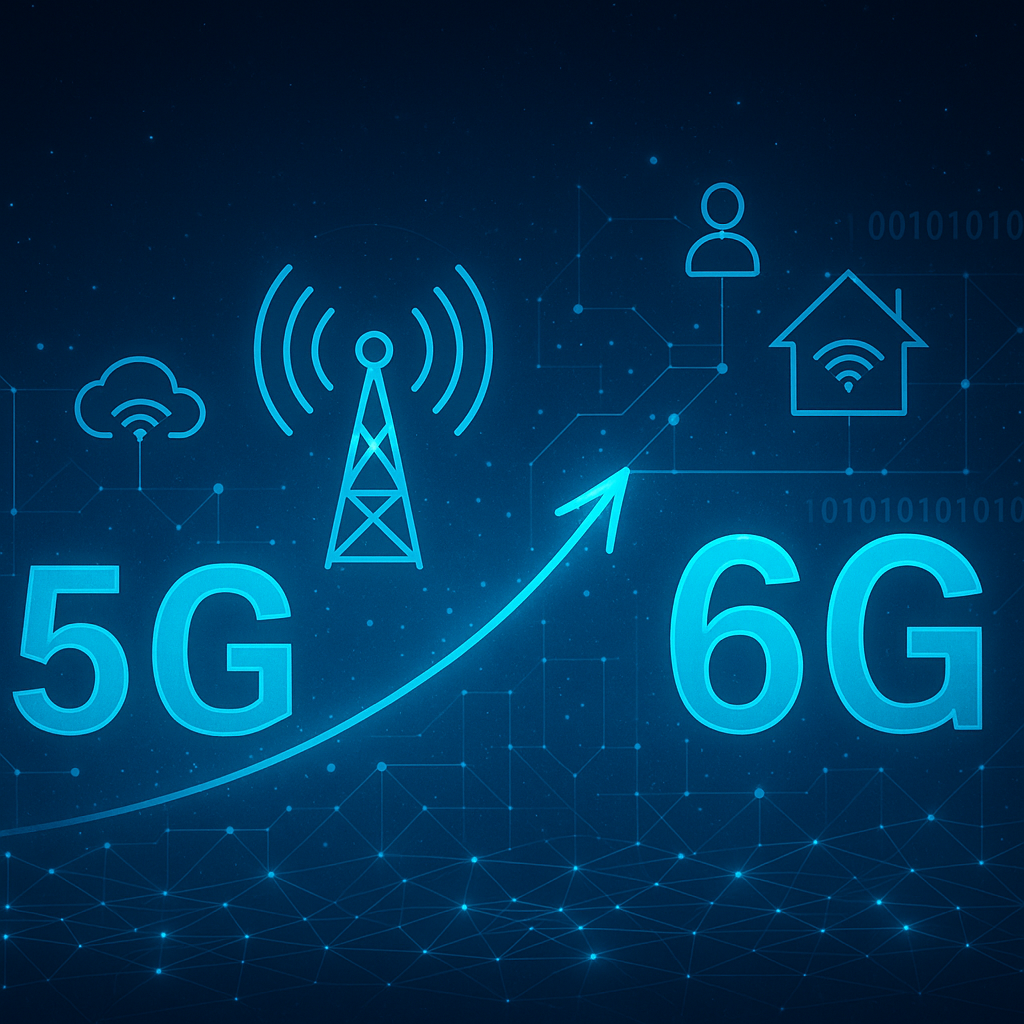
As 5G implementation continues, telecommunications researchers are already defining what 6G will look like. Expected to begin deployment around 2030, 6G is not just an incremental improvement. It represents a quantum leap in wireless technology.
Defining Features of 6G
First, 6G will operate in the terahertz frequency band, between one hundred gigahertz and ten terahertz, enabling unprecedented data transmission rates. Theoretical speeds could reach one terabit per second, allowing a user to download the equivalent of one hundred forty-two hours of Netflix content in a single second.
Second, latency will be reduced to microseconds from 5G's milliseconds—a thousand-fold improvement enabling truly real-time applications.
Third, unlike previous generations, 6G is being designed from the ground up with artificial intelligence integration at its core. This makes it an AI-native network design.
Fourth, beyond communications, 6G networks will double as high-precision positioning systems and even imaging platforms through spatial sensing and positioning capabilities.
North American 6G Initiatives
North America is positioning itself as a leader in 6G research and development. The Next G Alliance, formed in 2020, includes over eighty North American organizations working to establish 6G leadership. University research hubs at the University of Texas at Austin, the University of Toronto, and MIT have established dedicated 6G research centers with substantial federal and private funding. The U.S. and Canadian governments have committed preliminary funding for 6G research, recognizing its importance to economic competitiveness and national security.
Beyond Speed: The Transformative Applications
6G will enable applications that seem like science fiction today but will become integral to our daily lives by the mid-2030s.
Immersive Telepresence
With 6G, virtual meetings will not just feature high-definition video. They will create holographic representations of participants with perfect spatial audio, tactile feedback, and even scent transmission, making remote interactions virtually indistinguishable from being physically present.
Digital Twins on a Massive Scale
Cities will maintain complete, real-time digital replicas of their entire infrastructure, enabling unprecedented optimization of everything from traffic flow to energy consumption and emergency response.
Ambient Intelligence
Networks of sensors and AI systems will create environments that respond intelligently to human needs without explicit commands. Lighting, temperature, and information displays will adjust based on behavioral patterns and biometric signals.
Brain-Computer Interfaces
While still in early development, non-invasive brain-computer interfaces will benefit enormously from 6G's bandwidth and latency capabilities, potentially revolutionizing how we interact with technology.
The Challenges Ahead
Infrastructure Investment Requirements
The transition to 6G will require massive infrastructure investments estimated at $1.7 trillion across North America over the 2030 to 2035 period. This includes not only new cell towers and base stations but also significant fiber optic backbone expansions.
Spectrum Allocation and Management
Regulatory bodies like the FCC and ISED Canada face the challenge of efficiently allocating terahertz spectrum bands while ensuring fair competition and preventing monopolistic practices.
Energy Efficiency Concerns
Processing data at terabit speeds consumes substantial energy. 6G researchers are focused on developing radically more efficient components to prevent exponential growth in power consumption.
Digital Divide Implications
Without careful planning and policy intervention, 6G could exacerbate existing digital inequalities. Rural communities, which still struggle with basic broadband access in many regions, risk falling even further behind.
The North American Competitive Landscape
Industry Leaders to Watch
Nokia Bell Labs in New Jersey is pioneering terahertz research and quantum networking. Qualcomm in California is focused on 6G chipset development and AI-powered network optimization. Ericsson, with its North American headquarters in Texas, is advancing intelligent network automation and environmental sensing. Rogers Communications in Toronto is developing spectrum sensing technologies and rural connectivity solutions. Verizon in New York is building edge computing infrastructure and integrated satellite-terrestrial systems.
International Competition
While North America has established strong research initiatives, it faces intense competition from other regions. China has designated 6G development a national priority with substantial funding and coordination. South Korea and Japan are similarly advancing ambitious research programs. The European Union's Horizon Europe program includes significant 6G research funding with a focus on sustainable and human-centric applications.
Preparing for the 6G Future
For businesses, the time has come to assess how ultra-reliable, high-bandwidth, low-latency communications could transform their industry and business model. Investing in complementary technologies like edge computing, AI systems, and advanced sensors is worth serious consideration. Participating in standards development processes ensures that industry requirements are represented.
For policymakers, developing spectrum policy frameworks that enable innovation while protecting public interests is essential. Addressing digital divide concerns through targeted infrastructure subsidies and universal service requirements will be critical. Updating privacy and security regulations to address the new capabilities of sensing networks cannot wait.
For consumers, expect devices with vastly improved battery life as energy efficiency becomes paramount. Prepare for increasingly seamless integration between physical and digital experiences. And consider the privacy implications of ambient, always-connected environments.
Conclusion
The transition from 5G to 6G represents more than just another generational leap in wireless technology. It signals a fundamental transformation in the relationship between our physical and digital worlds. As North America continues investing in this next frontier, the coming decade will see unprecedented innovation in how we connect, communicate, and collaborate.
The question is not just about how fast our internet will become, but rather how these new capabilities will reshape industries, communities, and individual lives across the continent. From rural farmers leveraging precision agriculture to urban professionals using holographic telepresence, 6G will create opportunities that we are only beginning to imagine.
The views expressed in this article are those of the author and do not necessarily reflect the views of WriteFlow. WriteFlow does not endorse this content and does not guarantee its accuracy or completeness.




Comments (0)